



What's Happening?
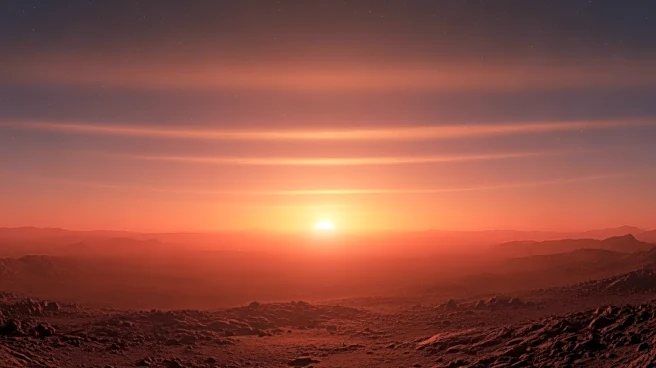
The European Space Agency's ExoMars Trace Gas Orbiter (TGO) has captured the most detailed images of a Martian sunset to date. On January 21, 2024, the orbiter, equipped with the Color and Stereo Surface Imaging System (CaSSIS), observed the Martian atmosphere
from the planet's shadow, revealing dozens of razor-thin atmospheric layers. These images, taken from about 250 miles above Terra Cimmeria, show the atmosphere's layered structure at twilight, with layers repeating from roughly 9 to 34 miles in altitude. The study, led by Nicolas Thomas from the University of Bern, focuses on high-precision planetary imaging and the physics of Martian sunsets. The images reveal changes in brightness and color, with blue wavelengths becoming more concentrated near the Sun due to forward scattering of light by dust particles.
Why It's Important?
These observations are significant as they provide new insights into the Martian atmosphere's composition and behavior. Understanding the atmospheric layers and their changes is crucial for climate modeling on Mars. The data can help scientists refine models of how dust and ice particles stack in the atmosphere, which is essential for planning future robotic missions. The detailed images also bridge the gap between orbital observations and ground-based measurements by landers and rovers, enhancing our understanding of Martian weather patterns and atmospheric dynamics. This research could inform future exploration strategies and improve the safety and efficiency of missions to Mars.
What's Next?
The ESA plans to continue these observations monthly to build a comprehensive dataset of Martian twilight conditions. This ongoing research aims to create a seasonal atlas of atmospheric layers, which will help scientists understand how these layers change with regional storms and seasonal variations. Future studies will focus on why certain layers change color at higher altitudes and how particle sizes and compositions evolve across different latitudes. These efforts will contribute to a more detailed understanding of Mars' climate and atmospheric processes, aiding in the preparation for future manned and unmanned missions to the Red Planet.