
What's Happening?
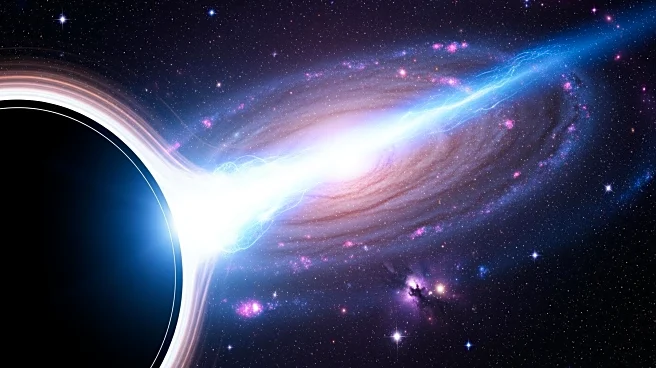
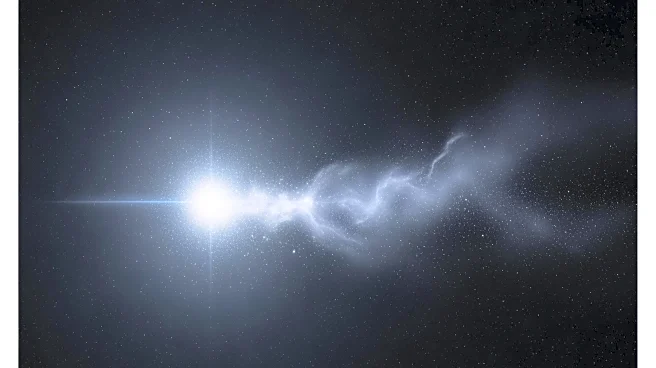
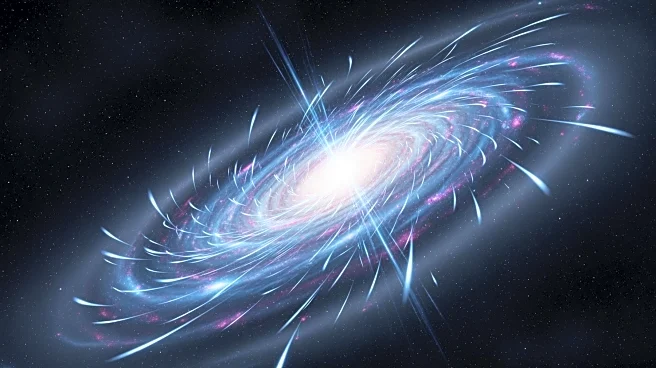
The European Space Agency (ESA) has reported a significant astronomical discovery involving a black hole within the spiral galaxy NGC 3783. This black hole, with a mass equivalent to 30 million suns, is consuming nearby material, resulting in the formation
of an active galactic nucleus. This nucleus is characterized by its extreme brightness and the emission of powerful jets and winds. Notably, one of these winds has been measured at an unprecedented speed of 130 million miles per hour, which is approximately 20% of the speed of light. This phenomenon was observed by an international research team led by Liyi Gu from the Space Research Organisation Netherlands (SRON). The winds are believed to be generated by the untwisting of the nucleus' magnetic field, a process similar to solar coronal mass ejections but on a much larger scale.
Why It's Important?
This discovery is significant as it provides new insights into the behavior of black holes and their influence on the galaxies they inhabit. The winds from active galactic nuclei, such as the one observed, play a crucial role in the development and evolution of galaxies. Understanding these processes can lead to a better comprehension of the history and dynamics of galaxies throughout the universe. The research also highlights the similarities between black holes and solar phenomena, suggesting that high-energy physics may operate in familiar ways across different cosmic environments. This could have implications for future studies in both astrophysics and cosmology.