


What's Happening?
Researchers have discovered that reproductively active female Antarctic krill are utilizing deep-sea hydrothermal vents for spawning, a finding that challenges the long-held belief that krill only spawn in the upper water column. Using a remotely operated
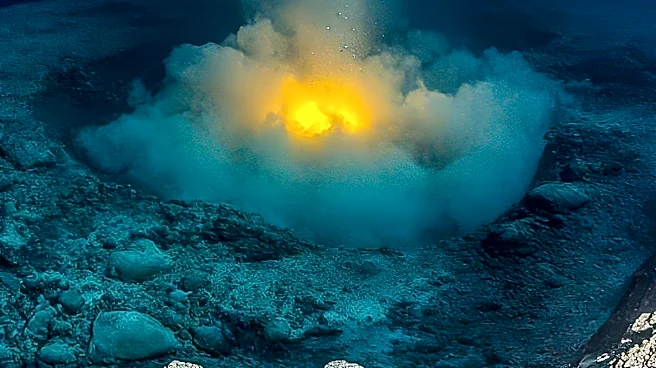
vehicle in the Bransfield Strait and the Scotia Arc, scientists observed egg-carrying (gravid) female Antarctic krill at depths exceeding 1,000 meters at Hook Ridge. Analysis of krill collected from these vent sites revealed gut bacteria, stable isotope signatures, and trace-metal levels consistent with feeding on chemosynthetic microbes found at the vents. Furthermore, video footage from Quest Caldera indicated a significant presence of nearly 2,000 gravid females around a vent field, suggesting this is not an isolated occurrence. The authors propose that these vents may offer spawning females crucial benefits such as warmth, a year-round food source, and essential trace metals like manganese and zinc.
Why It's Important?
This discovery holds significant implications for the understanding and management of the Southern Ocean ecosystem, particularly concerning the resilience of Antarctic krill populations. Antarctic krill are a foundational species in the Antarctic food web, and their health is vital for numerous marine animals, including penguins, seals, and whales. The identification of deep-sea hydrothermal vents as critical habitats for krill spawning introduces a new dimension to their life cycle and habitat requirements. This new understanding could influence fisheries management strategies and conservation efforts, especially in the context of climate change and increasing fishing pressure, which are already placing krill populations at risk. Protecting these newly identified spawning grounds could be crucial for ensuring the long-term sustainability of krill and the broader Antarctic ecosystem.
What's Next?
The researchers recommend that vent areas in the Bransfield Strait be considered in the planning for the proposed Domain 1 marine protected area. This suggests a potential shift in conservation priorities to include these deep-sea environments. Further research will be necessary to determine how widely krill utilize these vent habitats, as the current findings are based on a relatively small sample size. Scientists will likely focus on expanding their surveys to other vent sites and conducting more detailed studies on the physiological benefits krill derive from these environments. The findings could also prompt a re-evaluation of existing models for krill population dynamics and distribution, potentially leading to more accurate assessments of their vulnerability and resilience.
Beyond the Headlines
The revelation that Antarctic krill use deep-sea hydrothermal vents for spawning highlights the complex and often hidden interconnections within marine ecosystems. It underscores the limitations of current scientific understanding regarding deep-sea environments and the life forms they support. This discovery could inspire further exploration of deep-sea habitats, potentially uncovering other unknown critical life stages or ecological relationships for various species. Ethically, it reinforces the need for comprehensive environmental assessments that consider the full range of habitats utilized by species, including those in less accessible deep-sea regions, before implementing large-scale industrial activities like fishing. Culturally, it adds to the ongoing narrative of scientific discovery continually reshaping our perception of the natural world and the intricate strategies organisms employ for survival.