






What's Happening?
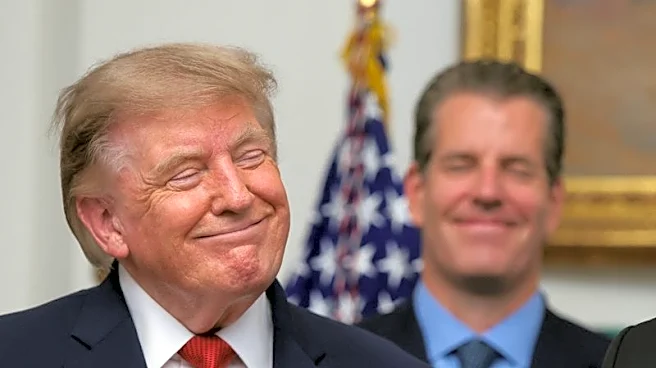
President Trump convened a meeting at the White House with crypto and finance executives, including Coinbase CEO Brian Armstrong, Ripple CEO Brad Garlinghouse, and Nasdaq CEO Adena Friedman. During the gathering, President Trump called on Congress to pass
a 'fair version' of the Clarity Act. This legislation aims to establish federal rules for digital assets and clarify the regulatory authority of the Securities and Exchange Commission (SEC) and the Commodity Futures Trading Commission (CFTC) over the industry. The President emphasized that such market structure legislation is crucial for the U.S. to maintain its leadership in commercial markets and innovation, particularly in areas like AI. The Clarity Act is expected to return to the Senate floor in September, though it requires approximately six Democratic votes to reach the 60-vote threshold for passage.
Why It's Important?
The push for the Clarity Act is significant for the U.S. digital asset industry, which has long sought clear regulatory guidelines. The current lack of a comprehensive framework has created uncertainty, potentially hindering innovation and driving crypto businesses overseas. President Trump's endorsement of the Act signals a potential shift towards a more defined regulatory environment, which could encourage investment and growth within the U.S. market. Clearer rules could expand product offerings and institutional activity for companies like Coinbase, directly impacting their valuation and operational scope. Furthermore, the President's remarks highlight a strategic competition with other countries, particularly China, to lead in emerging technologies and financial markets, underscoring the economic and national security implications of robust digital asset regulation.
What's Next?
The Clarity Act is anticipated to be brought back to the Senate floor in September for a procedural vote. Its passage will depend on securing bipartisan support, specifically an additional six Democratic votes. Following President Trump's call for a 'fair version' of the Act, stakeholders will be closely watching for any amendments or compromises that might facilitate its approval. The inaugural meeting of the Commodity Futures Trading Commission's Innovation Advisory Committee, scheduled for Thursday, will also provide further insights into the regulatory direction for digital assets. The outcome of these legislative and regulatory efforts will determine the future landscape for crypto companies in the U.S., influencing their ability to innovate, expand, and compete globally.
Beyond the Headlines
Beyond the immediate legislative push, President Trump's advocacy for the Clarity Act reflects a broader strategic vision for the U.S. to dominate the future of commercial markets and technological innovation. His criticism of the previous administration's regulatory approach, which he characterized as driving businesses overseas, suggests a policy shift aimed at fostering a more favorable domestic environment for digital assets. This includes leveraging policies such as a strategic Bitcoin reserve and a ban on a U.S. central bank digital currency. The emphasis on keeping AI and other advanced technologies within the U.S. underscores the long-term economic and geopolitical implications of digital asset regulation. The debate over the Clarity Act is not just about crypto; it's about the U.S.'s position in the global technological race and its ability to attract and retain cutting-edge industries.