







What's Happening?
UC Berkeley Professor Stuart Russell, a leading expert in artificial intelligence, is urgently advocating for a ban on the development of AI weapons, particularly small, anti-personnel autonomous weapons. Russell, who co-founded the Center for Human-Compatible
Artificial Intelligence and authored a foundational AI textbook, has been warning about the dangers of autonomous weapons for over a decade. He emphasizes that these weapons, if produced cheaply and at scale, could function as weapons of mass destruction, allowing a single individual to launch millions of weapons and kill millions of people. Russell notes that the technology is rapidly advancing, with evidence suggesting both Russia and Ukraine are increasingly moving towards autonomous target selection in drones due to signal-jamming issues. The U.S. and China are also actively developing AI weapons systems, while international law struggles to keep pace with these technological advancements. Israel is reportedly using multiple AI systems to identify targets in Gaza. Russell believes that a greater public understanding of these stakes is crucial to prompt the development of necessary legal frameworks.
Why It's Important?
Professor Russell's call for a halt to AI weapons development is critically important due to the profound ethical, legal, and societal implications of autonomous warfare. The potential for mass destruction from easily proliferated AI weapons fundamentally alters the landscape of global security, introducing a new category of weapons of mass destruction that could be accessible to a wider range of actors. This development poses an existential threat, as it removes human decision-making from the loop of lethal force, raising concerns about accountability, proportionality, and the potential for unintended escalation. The current lag in international law compared to technological advancements means there are insufficient frameworks to govern the use and proliferation of these weapons, creating a dangerous vacuum. The involvement of major global powers like the U.S. and China in this arms race further underscores the urgency of the issue, as it could lead to a destabilizing arms race with unpredictable consequences. The use of AI systems in conflicts, such as in Gaza, demonstrates that these technologies are already being deployed, making the debate about their regulation not theoretical but immediate and pressing. The lack of public awareness, as highlighted by Russell, means that democratic processes may not adequately address these critical issues before irreversible technological milestones are reached.
What's Next?
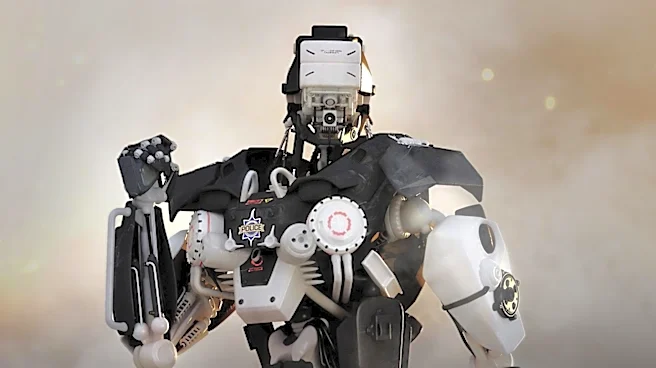
The immediate next step, as advocated by Professor Russell, is to ban small, anti-personnel autonomous weapons to prevent their mass production and proliferation. This would require international cooperation and the establishment of new treaties or amendments to existing international humanitarian law. Efforts will likely focus on raising public awareness and engaging policymakers to understand the severe risks associated with AI weapons. Russell's continued advocacy, including through initiatives like the 'Slaughterbots' short film, aims to galvanize public and political will for regulation. Discussions within international bodies, such as the United Nations, will be crucial to developing a consensus on the definition, scope, and prohibition of autonomous weapons. The U.S. and other leading nations will face increasing pressure to either lead or participate in these regulatory efforts, balancing national security interests with the imperative to prevent a new arms race. The academic and scientific communities will also continue to play a vital role in researching the implications of AI in warfare and informing policy debates. Without concerted action, the trajectory of AI weapons development suggests a future where autonomous systems could significantly reshape conflict and human security.
Beyond the Headlines
Beyond the immediate policy and security concerns, the development of AI weapons touches upon fundamental ethical and philosophical questions about human control over violence and the nature of warfare itself. The concept of machines making life-or-death decisions on the battlefield challenges long-held principles of human dignity and moral responsibility. This shift could lead to a dehumanization of conflict, where the psychological barriers to initiating violence are lowered, potentially increasing the frequency and brutality of wars. The proliferation of cheap, scalable AI weapons also raises concerns about their potential use by non-state actors, further complicating global security. Culturally, the integration of AI into military systems could alter public perception of war, making it seem more distant and abstract, thereby reducing public engagement and oversight. Legally, establishing accountability for actions taken by autonomous weapons systems presents a complex challenge, as it blurs the lines of responsibility between programmers, manufacturers, and military commanders. The race to develop these technologies also highlights a broader societal tension between technological innovation and ethical governance, urging a re-evaluation of how humanity manages powerful new tools to ensure they serve, rather than threaten, human well-being.