




What's Happening?
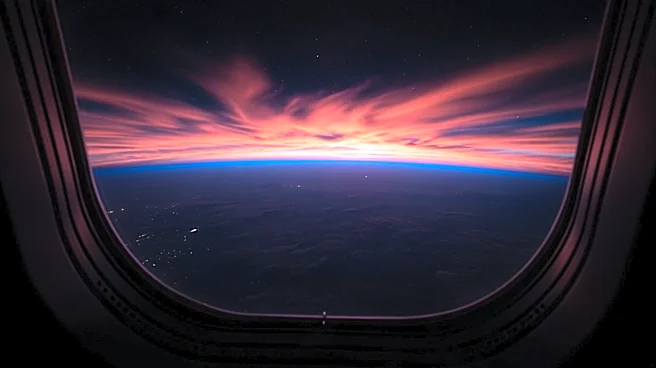
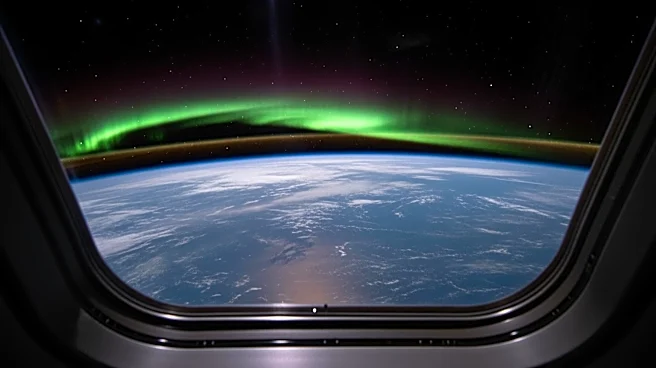
French astronaut Sophie Adenot, aboard the International Space Station (ISS), captured a remarkable image of the southern aurora, also known as the aurora australis, while orbiting 431 kilometers above Earth. The photograph, taken on May 7, 2026, shows
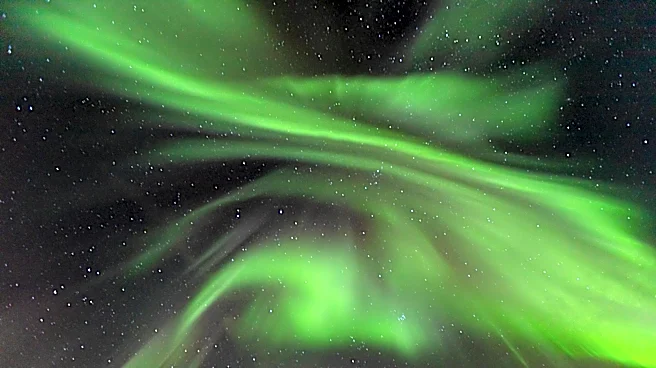
vibrant green and pink bands of light over the Indian Ocean, near the coast of Perth, Australia. This phenomenon occurs when charged solar particles interact with Earth's magnetic field, colliding with oxygen and nitrogen molecules in the atmosphere to release energy as light. The image provides a unique perspective, revealing the aurora as a luminous layer surrounding the planet, a view not typically seen from the Earth's surface.
Why It's Important?
The capture of the southern aurora from space offers significant scientific insights into the interaction between solar activity and Earth's magnetic field. Auroras serve as visible indicators of space weather, which can impact satellites, communication systems, and power grids. By studying these phenomena, scientists can better understand solar storms and their potential effects on technology and infrastructure. The ISS provides a unique vantage point for observing such atmospheric events, contributing to research on space weather and solar activity. This understanding is crucial for preparing for and mitigating the impacts of intense solar storms on Earth.
What's Next?
Continued observation and documentation of auroras from the ISS will enhance scientific knowledge of space weather. Astronauts on the ISS, like Sophie Adenot, will likely continue to capture images of auroras and other atmospheric phenomena, contributing to ongoing research. These efforts will aid in developing strategies to protect technology and infrastructure from the effects of solar activity. Additionally, the data collected can improve predictive models of space weather, helping to safeguard communication and navigation systems that are vital to modern society.
Beyond the Headlines
The visual impact of auroras, as seen from space, underscores the beauty and complexity of Earth's atmospheric phenomena. Such images can inspire public interest in space exploration and environmental science. They also highlight the importance of international collaboration in space missions, as demonstrated by the diverse crew aboard the ISS. The ability to observe Earth from space provides a broader perspective on the planet's natural processes, fostering a deeper appreciation for the interconnectedness of Earth's systems and the need for global cooperation in addressing environmental challenges.