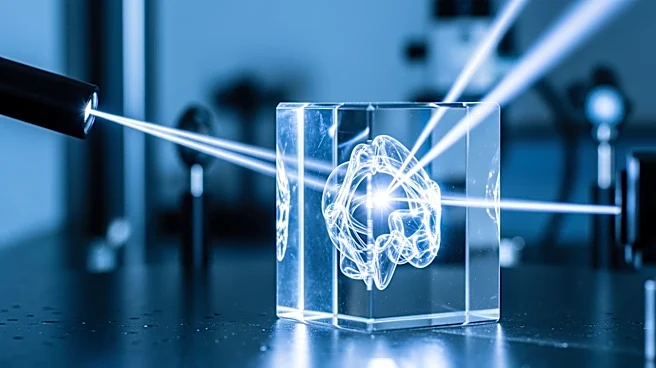








What's Happening?
Researchers from the XPANCEO Emerging Technologies Research Center, in collaboration with Nobel Laureate Prof. Konstantin Novoselov, have discovered a novel optical behavior in arsenic trisulfide (As2S3), a crystalline van der Waals semiconductor. This
material can be permanently altered by light, allowing it to be shaped at the nanoscale using continuous-wave light. This discovery eliminates the need for costly cleanroom fabrication or advanced laser systems. The material's refractive index, which describes how much it bends or slows light, can be significantly altered by light exposure, a phenomenon known as photorefractivity. This capability is crucial for creating optical functions directly within the material, supporting technologies in telecommunications, sensors, and security. The researchers demonstrated this by using a laser to create a microscopic portrait of Albert Einstein on the material, achieving high precision and resolution.
Why It's Important?
The discovery of photorefractivity in As2S3 has significant implications for the field of photonics, which involves the use of light to perform functions traditionally handled by electronics. This advancement could lead to the development of more efficient and compact optical devices, such as smart contact lenses and augmented reality glasses. The ability to directly write optical functions into materials could reduce manufacturing complexity and costs, while also enhancing the performance and capabilities of devices. This technology could also improve anti-counterfeiting measures and traceability through unique optical identifiers. Overall, this breakthrough represents a step forward in the development of next-generation technologies driven by light.