






What's Happening?
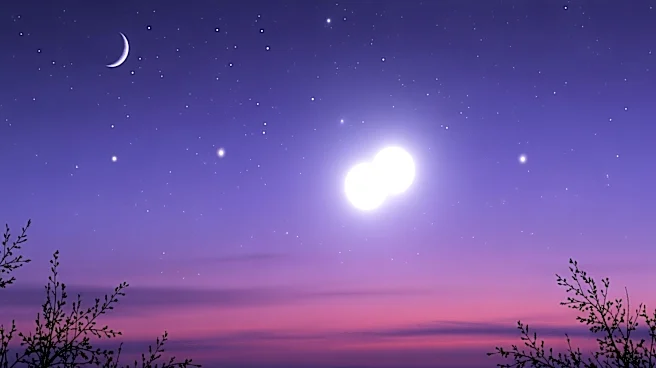
NASA has released its skywatching tips for June 2026, highlighting several celestial events. Venus and Jupiter will appear close together in a planetary conjunction on June 9, followed by Mercury joining the scene from June 11 to 15. On June 17, a lunar
occultation will occur, where the Moon passes in front of Venus, visible from parts of the U.S., Canada, Brazil, and Venezuela. The June solstice on June 21 marks the start of astronomical summer in the Northern Hemisphere. The month also offers opportunities to observe deep-sky objects like the Summer Triangle and various nebulae.
Why It's Important?
These skywatching events provide opportunities for public engagement with astronomy and space science, fostering interest and education in these fields. The planetary conjunctions and lunar occultation are accessible events that can be observed without specialized equipment, making them ideal for amateur astronomers and the general public. The June solstice is a significant astronomical event that marks seasonal changes, influencing cultural and scientific activities. Observing deep-sky objects can inspire interest in astrophotography and the study of celestial phenomena.