



What's Happening?
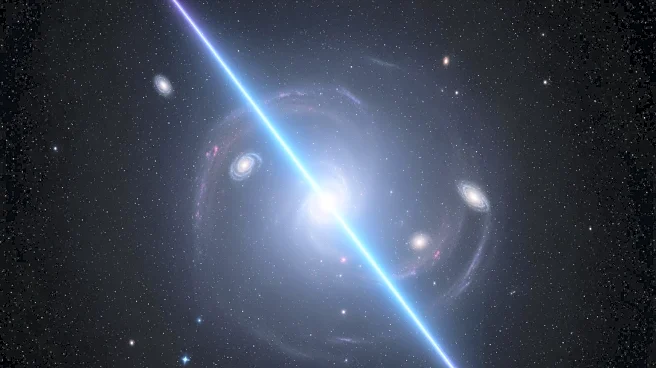
Astronomers have discovered the most distant and brightest 'space laser,' known as a gigamaser, located 8 billion light-years away. This phenomenon was detected by the MeerKAT radio telescope in South Africa, aided by gravitational lensing from a foreground
galaxy. The gigamaser is the result of a galactic collision that compresses gas and triggers star formation, leading to the emission of intense radio waves. This discovery surpasses the previous distance record of 5 billion light-years and highlights the potential of MeerKAT to investigate high-redshift hydroxyl megamasers.
Why It's Important?
The discovery of this gigamaser provides valuable insights into the processes occurring in distant galaxies, particularly those involving massive galactic collisions. It enhances our understanding of galaxy formation and evolution, as well as the conditions that lead to such powerful emissions. The findings could also contribute to the study of cosmic phenomena and the role of gravitational lensing in amplifying distant signals. This research underscores the capabilities of modern radio telescopes and their role in advancing astrophysical knowledge.
What's Next?
The study of this gigamaser will continue, with researchers aiming to explore its properties and implications further. The findings will be published in the Monthly Notices of the Royal Astronomical Society Letters. Future observations may focus on identifying other similar phenomena and understanding their impact on galaxy dynamics. The ongoing research could also lead to the development of new techniques for detecting and analyzing distant cosmic events, potentially opening new avenues in the field of astrophysics.