


What's Happening?
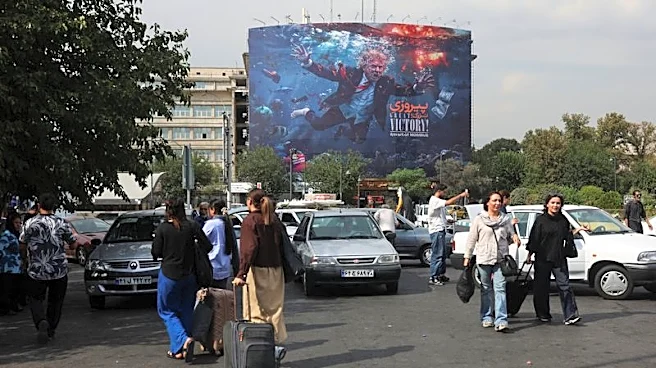
Democratic US Senator Chris Murphy has publicly denounced the Trump administration's recent sanctions against Iran, labeling them as a 'publicity stunt' and 'empty rhetoric.' According to Pars Today, Senator Murphy stated that none of President Trump's
stated war aims against Iran have been achieved. He highlighted that the Iranian government remains stable, retaining its missile, drone, and nuclear programs, and has even been observed showcasing new missile sites. Murphy further argued that the sanctions have failed to exert real pressure on Iran, noting that Iran can economically sustain itself as long as China continues to purchase its oil. He suggested that President Trump's focus on Iran has inadvertently granted China additional leverage in international relations, potentially leading to concessions from the U.S. on issues like AI microchips or Taiwan in exchange for reduced Chinese oil purchases from Iran. Murphy concluded that the U.S. is not applying significant pressure on China due to concerns about retaliation, specifically the potential cutoff of critical mineral exports to the United States.
Why It's Important?
Senator Murphy's critique underscores a significant debate within U.S. foreign policy regarding the effectiveness and consequences of sanctions as a tool for international diplomacy. His assertion that the sanctions are merely a 'publicity stunt' suggests a perceived lack of strategic impact, potentially undermining the credibility of U.S. foreign policy objectives. The argument that Iran remains stable and continues its military and nuclear programs despite the sanctions raises questions about the efficacy of the current approach and its ability to achieve desired outcomes. Furthermore, Murphy's analysis of China's role highlights the complex interdependencies in global geopolitics. The potential for China to leverage its economic relationship with Iran to gain concessions from the U.S. on other critical issues, such as technology or Taiwan, indicates a broader strategic challenge for American foreign policy. This situation could lead to a re-evaluation of sanction strategies and their unintended consequences on global power dynamics and economic stability, particularly concerning energy markets and critical supply chains.
What's Next?
The ongoing debate surrounding the effectiveness of U.S. sanctions on Iran is likely to continue, especially as the 2026 political landscape evolves. Senator Murphy's comments could fuel further discussions within Congress and among foreign policy experts regarding alternative approaches to managing relations with Iran and addressing its nuclear program. The Trump administration may face increased scrutiny to demonstrate tangible results from its sanction policies or to articulate a clearer long-term strategy. Conversely, the administration might double down on its current approach, emphasizing the importance of continued pressure. The role of China in circumventing U.S. sanctions will also remain a critical factor, potentially leading to increased diplomatic efforts to influence China's purchasing decisions or to develop new strategies to counter such circumvention. The broader implications for global energy markets and the supply of critical minerals will also be closely watched, as any significant shifts could have ripple effects on the U.S. economy and national security.
Beyond the Headlines
Beyond the immediate policy implications, Senator Murphy's remarks touch upon deeper issues concerning the nature of international power and economic leverage. The idea that a nation's 'obsession' with one geopolitical adversary can inadvertently empower another, as suggested by Murphy regarding President Trump's focus on Iran and China's increased leverage, highlights the intricate and often unpredictable outcomes of foreign policy decisions. This situation also brings to light the ethical considerations of sanctions, particularly when their effectiveness is questioned and their impact on the targeted population or regional stability is debated. The reliance on sanctions as a primary foreign policy tool, without clear evidence of achieving stated goals, could lead to a broader re-evaluation of their utility and the potential for unintended humanitarian or economic consequences. Moreover, the discussion about China's role in global trade and its influence on U.S. foreign policy underscores the ongoing shift in global power dynamics, where economic interdependence can create both opportunities and vulnerabilities for major world powers.