







What's Happening?
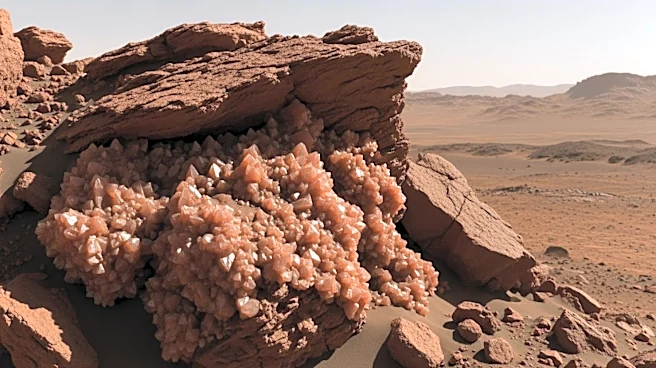
NASA's Curiosity rover has moved beyond the boxwork terrain to explore a layered sulfate unit on Mars. The rover's recent drive crossed the southernmost contact of the boxwork terrain, allowing scientists to study changes across this boundary. The team,
led by Lucy Thompson, is examining the chemical and textural differences between the boxwork-bearing bedrock and the sulfate unit. Despite challenges with unstable ground, the rover successfully repositioned to conduct MAHLI imaging and APXS analysis. The rover's activities include brushing and analyzing bedrock spots, capturing Mastcam mosaics, and monitoring atmospheric conditions.
Why It's Important?
The investigation of the sulfate unit is significant for understanding Mars' geological history and the environmental conditions that shaped its surface. By studying the chemical composition and textures of the bedrock, scientists can infer the depositional environments and potential alterations that occurred. This research contributes to the broader goals of Mars exploration, providing insights into the planet's past climate and potential habitability. The rover's ability to conduct detailed analyses despite challenging conditions highlights the advancements in robotic exploration technology.
What's Next?
Curiosity will continue its exploration of the sulfate unit, conducting further analyses to compare current exposures with previously observed textures. The rover's ongoing mission aims to gather more data on Mars' geology and climate, contributing to future exploration plans. The team will analyze the collected data to understand the formation of the polygonal textures and their implications for Mars' history. As the rover progresses, it will encounter new challenges and opportunities for scientific discovery, furthering our understanding of the Red Planet.