


What's Happening?
The week of November 13 to 20, 2026, offers several notable astronomical events for skygazers. Mercury, having reappeared in the morning sky, will be visible above the eastern horizon an hour before sunrise, moving eastward. Venus, brighter than Mercury, will also
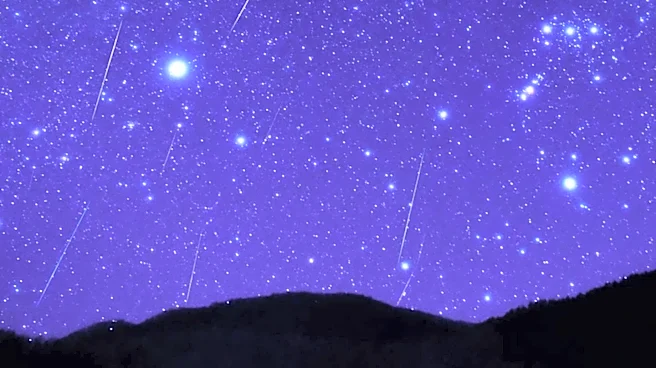
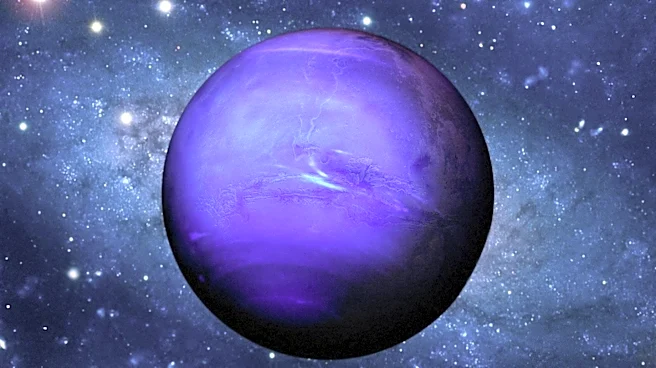
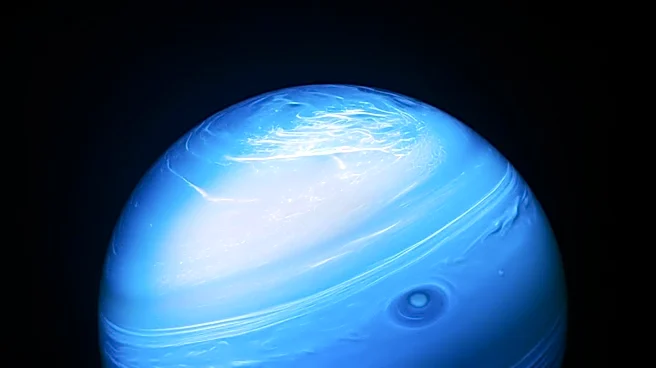
be prominent in the morning sky, passing 1.8 degrees north of Spica on November 19. Jupiter and Mars, approaching opposition in February, will dominate the early morning sky, with Mars passing 1.2 degrees north of Jupiter on November 14. Jupiter's Galilean moons will also present a show, with Io's shadow transiting the planet on November 15. Saturn's largest moon, Titan, will be visible south of the planet on November 16, alongside its ring system. The Leonid meteor shower will peak on November 18, offering opportunities to observe meteors in the hours before dawn. Finally, the Moon will pass 5 degrees north of Neptune and 7 degrees north of Saturn on November 20, making the trio visible in the southeastern sky after sunset, though Neptune will require optical aid.
Why It's Important?
These celestial events provide unique opportunities for both amateur and professional astronomers to observe and study our solar system. The close approaches and transits of planets and moons offer dynamic views that can enhance public engagement with science and astronomy. For researchers, precise observations of planetary positions and phenomena contribute to refining orbital models and understanding the physical characteristics of celestial bodies. The visibility of meteor showers, like the Leonids, allows for the study of cometary debris and the dynamics of dust trails in space. Public awareness of these events can also inspire future generations of scientists and engineers, fostering a deeper appreciation for the cosmos. The ability to track and predict these occurrences demonstrates the advanced state of astronomical science and its continuous development.
What's Next?
Observers can plan their viewing sessions around these dates, utilizing binoculars or telescopes for enhanced visibility, especially for fainter objects like Neptune and the moons of Jupiter and Saturn. Detailed sky charts and astronomical applications can help pinpoint the exact locations of these celestial bodies. Beyond this week, the continuous monitoring of planetary movements and meteor showers will persist, contributing to long-term datasets used for scientific analysis. Future astronomical events, including other meteor showers, planetary oppositions, and lunar phases, will continue to be tracked and publicized, ensuring ongoing opportunities for observation and study. The data collected from such observations, even by amateur astronomers, can sometimes contribute to larger scientific endeavors, particularly in areas like variable star observation or asteroid tracking.
Beyond the Headlines
The regular occurrence of these astronomical events serves as a constant reminder of the vast and dynamic nature of our universe. Beyond their scientific value, these celestial displays hold cultural and historical significance, having inspired humanity for millennia. The ability to predict and observe these phenomena reflects humanity's enduring quest for knowledge and understanding of our place in the cosmos. The accessibility of such events, often visible with minimal equipment, democratizes scientific engagement, allowing individuals worldwide to connect with the wonders of space. Furthermore, the study of meteor showers, like the Leonids, provides insights into the origins of our solar system, as these debris trails are remnants from comets that have traversed our cosmic neighborhood for eons. This continuous observation reinforces the interconnectedness of all celestial bodies within our solar system.