
What's Happening?
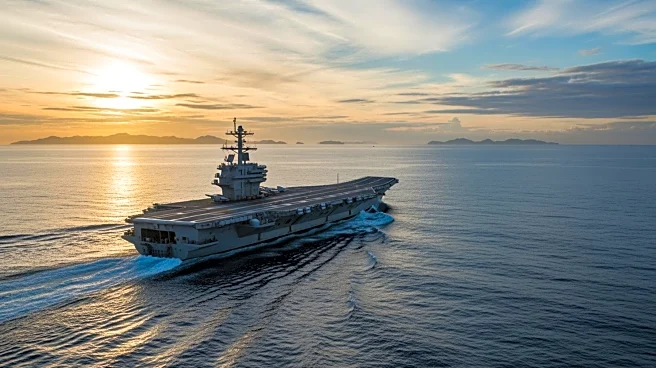
In 2025, the United States deployed four aircraft carriers across the Indo-Pacific region to project power and maintain naval supremacy. The USS Carl Vinson, USS Nimitz, and USS George Washington completed
their missions, leaving the USS Abraham Lincoln as the sole carrier in the area. These deployments are part of the U.S. strategy to ensure a free and open Indo-Pacific, countering China's growing naval capabilities. The carriers participated in various operations, including joint exercises with allies and combat missions in the Middle East. The presence of these carriers serves as a deterrent against potential adversaries and underscores the U.S. commitment to regional security.
Why It's Important?
The deployment of U.S. aircraft carriers in the Indo-Pacific is a critical component of American military strategy, aimed at countering China's influence and ensuring stability in a region vital to global trade. Aircraft carriers are symbols of military strength, providing the U.S. with the ability to project power and respond to crises swiftly. The presence of these carriers reassures allies and partners of the U.S. commitment to their defense and deters potential aggression from adversaries. This strategic positioning also supports freedom of navigation operations, which are essential for maintaining open sea lanes crucial for international commerce.
What's Next?
The U.S. is expected to maintain a persistent carrier presence in the Indo-Pacific to counter China's naval expansion and assert its influence in the region. Future deployments may involve increased collaboration with allies through joint exercises and strategic partnerships. The U.S. Navy will likely continue to adapt its strategies to address emerging threats and enhance its capabilities in the region. Diplomatic efforts may also be intensified to strengthen alliances and ensure a coordinated approach to regional security challenges.