








What's Happening?
The Board of Executive Directors of the Inter-American Development Bank (IDB) has approved a $450 million Programmatic Policy-Based Loan (PBP) for Colombia. This loan is aimed at strengthening energy security and the financial sustainability of Colombia’s
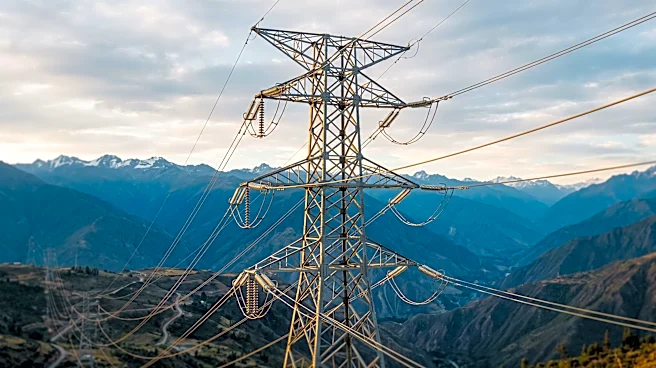
power sector. The operation is designed to encourage private investment in power generation and transmission, improve the execution of public resources for expanding electricity access in rural areas, promote the sector's financial sustainability, and help reduce the fiscal deficit associated with subsidies. The program is expected to add 24 GW of capacity to the system and benefit approximately 17 million users of Colombia’s National Interconnected System by addressing projected deficits and enhancing energy security. Additionally, about 1.3 million households currently without electricity are anticipated to gain access through gradual coverage expansion.
Why It's Important?
This significant IDB loan to Colombia's energy sector holds substantial importance for U.S. interests, particularly in the context of regional stability and economic partnerships. A robust and sustainable energy sector in Colombia can contribute to its economic growth and political stability, which are key U.S. foreign policy objectives in Latin America. Enhanced energy security reduces Colombia's vulnerability to external shocks and strengthens its capacity to participate in regional energy markets, potentially fostering greater economic integration. The emphasis on private investment and rural electrification aligns with broader development goals that can mitigate social inequalities and reduce potential drivers of instability. For U.S. businesses, a more stable and predictable energy market in Colombia could present new investment opportunities in infrastructure and technology, while also ensuring a more reliable supply chain for goods and services that rely on stable energy. The reduction of fiscal deficits through subsidy reform also signals a move towards greater fiscal responsibility, which is generally viewed favorably by international financial markets and potential investors.
What's Next?
The $450 million loan has a 20-year repayment term, a five-and-a-half-year grace period, and an interest rate based on SOFR. Colombia will implement a series of reforms and actions to transform its electricity market. These include long-term contracting auctions for financing generation and storage, regulations enabling the use of batteries, release of blocked grid connection capacity, and new power transmission works in the Caribbean region. The program also aims for regional integration with Andean countries and Panama and the creation of the Single Fund for Energy Solutions (FONENERGÍA) for rural electrification. Furthermore, it will involve the replacement of consumption subsidies with distributed self-generation. These measures are expected to drive a profound transformation of Colombia's electricity market, with ongoing monitoring by the IDB to ensure the program's objectives are met.
Beyond the Headlines
The IDB's support for Colombia's energy sector reflects a broader strategic shift towards sustainable and resilient energy systems in Latin America. The focus on integrating renewable energy sources, such as batteries, and expanding rural access addresses both climate change concerns and social equity. This initiative could serve as a blueprint for other developing nations seeking to modernize their energy infrastructure while simultaneously tackling environmental and social challenges. The move away from consumption subsidies towards distributed self-generation is a significant policy shift, promoting energy independence and potentially reducing the long-term fiscal burden on the government. This approach could also stimulate local economies by fostering new industries and job creation in renewable energy and related technologies, contributing to a more diversified and resilient economic landscape in Colombia.