





What's Happening?
A new study conducted by researchers at Montana State University (MSU) has found that heatwaves significantly increase the rate of mountain snowpack melting. However, the study also revealed that this accelerated melting does not consistently lead to
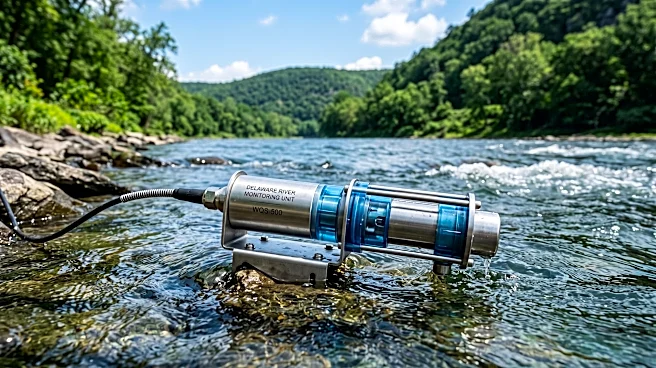
an immediate increase in streamflow. Published on October 1 in the peer-reviewed journal Environmental Research Letters, the research, funded by the National Science Foundation, analyzed data from 823 Snow Telemetry (SNOTEL) stations across the Western United States from 2001 to 2024. These stations, operated by the U.S. Department of Agriculture’s Natural Resources Conservation Service, monitor snowpack, precipitation, and temperature. Siwei He, assistant professor of civil engineering at MSU and co-author, highlighted the value of this long-term observational dataset. The study defined a heatwave as three or more consecutive days with temperatures exceeding the 30-year historical average by more than twice the typical temperature variation. At 98% of affected SNOTEL stations, snow melted faster during heatwaves, with an 80% increased likelihood of faster-than-normal snowmelt compared to normal conditions. Despite this, only about 55% of 168 headwater watersheds affected by heatwaves showed increased streamflow, indicating an 'asymmetric response,' according to lead author Haonan Guo, a civil engineering doctoral student at MSU.
Why It's Important?
This research is critically important for water resource management and climate change adaptation in the Western United States. Mountain snowpack acts as a natural reservoir, supplying water for communities, agriculture, and ecosystems as it gradually melts. The study's findings suggest that heatwaves disrupt this seasonal timing, potentially leading to less snow available during warmer months. This could complicate irrigation schedules and other water needs, impacting agricultural productivity and urban water supplies. The 'asymmetric response'—where increased snowmelt doesn't always translate to immediate streamflow—raises questions about water loss pathways, such as evaporation or soil absorption, which need further investigation. Understanding these dynamics is crucial for improving predictions of water availability and developing effective strategies to manage water resources in a changing climate. The study underscores the complex interplay between atmospheric conditions and hydrological systems, highlighting the need for nuanced approaches to water conservation and planning.
What's Next?
The MSU researchers plan to further investigate the fate of the water that does not immediately appear as increased streamflow. This next phase of research will involve tracing snowpack losses through different pathways using additional observations and models. The goal is to explain why snowpack and river responses diverge and to improve predictions regarding when mountain water becomes available downstream. Such advancements in understanding could lead to more accurate water supply forecasts, enabling better planning for agricultural irrigation, municipal water use, and ecosystem management. The findings will also inform policy decisions related to climate change mitigation and adaptation strategies in the Western U.S., particularly concerning water infrastructure and conservation efforts. Continued monitoring and research are essential to address the long-term implications of heatwave-induced snowmelt on regional water security.