
What's Happening?
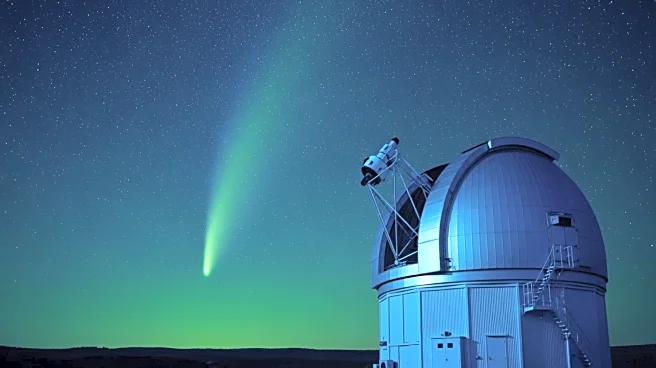
The Gemini North telescope, located on Maunakea in Hawai'i, has captured new images of Comet 3I/ATLAS, revealing a greenish hue as it reemerges from behind the sun. This observation was part of a public
outreach initiative called 'Shadow the Scientists,' which allows students worldwide to participate in real-time astronomical observations. The images were taken using the Gemini Multi-Object Spectrograph (GMOS) and show the comet against a backdrop of streaking stars, a result of the telescope's imaging technique. The greenish glow is attributed to the emission of light by gases in the comet's coma, particularly diatomic carbon, which emits green wavelengths as it evaporates due to the sun's heat. This initiative, led by Bryce Bolin from Eureka Scientific, aims to connect the public with scientific research and demystify the data collection process.
Why It's Important?
This event highlights the intersection of cutting-edge scientific research and public engagement. By involving the public, especially students, in observing sessions, the initiative not only advances scientific knowledge but also inspires future generations of scientists. The observation of Comet 3I/ATLAS provides valuable data on interstellar objects, contributing to our understanding of their behavior and composition as they interact with the solar system. The greenish hue observed in the comet offers insights into the chemical processes occurring as it heats up, which can inform future studies of similar celestial bodies. This initiative also emphasizes the importance of transparency in scientific research, fostering a greater appreciation and understanding of astronomy among the general public.
What's Next?
The Gemini North telescope will continue to monitor Comet 3I/ATLAS as it moves away from the sun and cools down. Scientists are particularly interested in observing any delayed reactions in the comet's behavior, such as the evaporation of new chemicals or potential outbursts. These observations will help researchers understand the thermal dynamics of comets and their chemical compositions. The ongoing public engagement through 'Shadow the Scientists' will continue to provide educational opportunities, allowing participants to witness and contribute to real-time scientific discoveries. This approach aims to maintain public interest in astronomy and encourage more people to pursue careers in science.
Beyond the Headlines
The collaboration between NOIRLab and 'Shadow the Scientists' represents a broader trend in science communication, where transparency and public involvement are becoming integral to research projects. By demystifying the scientific process, such initiatives can build public trust in science and encourage informed discussions about scientific advancements. Additionally, the study of interstellar objects like Comet 3I/ATLAS can have implications for understanding the origins of the solar system and the potential for life beyond Earth. As more interstellar objects are discovered, these studies could lead to significant breakthroughs in planetary science and astrobiology.