





What's Happening?
A Missouri judge has ruled that new U.S. House districts, supported by President Trump, can be utilized in the upcoming November elections. Cole County Circuit Judge Daniel Green rejected an attempt to subject these Republican-friendly districts to a statewide
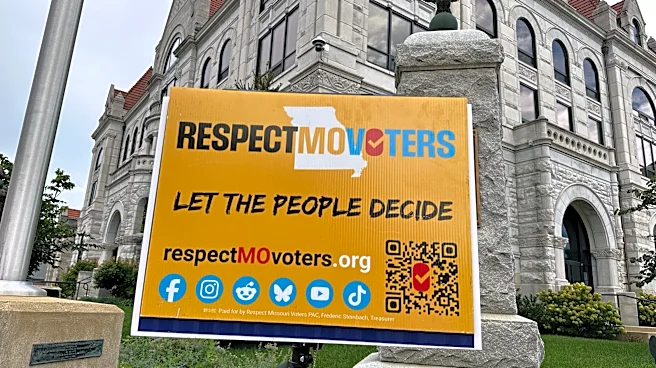
vote. This decision follows the use of these new districts in the August primaries. Missouri Secretary of State Denny Hoskins had previously dismissed a petition seeking a November referendum on the map, arguing that the state's constitution does not permit referendums on congressional redistricting. The judge's ruling aligns with Hoskins' position, stating that the Missouri Constitution does not explicitly reallocate authority over congressional redistricting from the General Assembly to a referendum process. The case is anticipated to be appealed to the state Supreme Court.
Why It's Important?
This ruling is a significant victory for Republicans aiming to maintain their narrow majority in the U.S. House. The new congressional map in Missouri is designed to favor Republicans, potentially shifting the state's House delegation from six Republicans and two Democrats to seven Republicans and one Democrat. This mid-decade redistricting effort, prompted by President Trump's call for Republican-led states to redraw boundaries to their advantage, is part of a broader national strategy. Republicans hope to gain as many as 16 additional seats from new House maps enacted in eight states, including Missouri. The decision also highlights ongoing legal disputes regarding referendum rights and the interpretation of state constitutions concerning legislative powers versus direct voter initiatives.
What's Next?
The case is highly likely to be appealed to the Missouri Supreme Court. Opponents of the redistricting plan, such as Richard von Glahn, executive director of People Not Politicians, have already announced their intention to appeal, seeking to enforce what they view as constitutional rights. The November ballot must be finalized by September 8, and the courts are expected to expedite the resolution of this case. If the Supreme Court upholds the current ruling, the new districts will remain in effect for the general election. Conversely, a reversal could lead to further complications, potentially requiring a reversion to older district maps or creating logistical challenges for the election.
Beyond the Headlines
The Missouri redistricting case underscores a deeper national trend of partisan gerrymandering and the strategic use of redistricting to secure political advantages. The debate over whether congressional redistricting should be subject to voter referendums touches upon fundamental questions of democratic representation and the balance of power between legislative bodies and direct citizen initiatives. The legal arguments center on the interpretation of constitutional language, particularly where it does not explicitly forbid or permit certain actions. This situation reflects the increasing polarization in U.S. politics, where every electoral advantage, no matter how small, is fiercely contested, potentially leading to long-term shifts in political landscapes and voter confidence in election integrity.