
What's Happening?
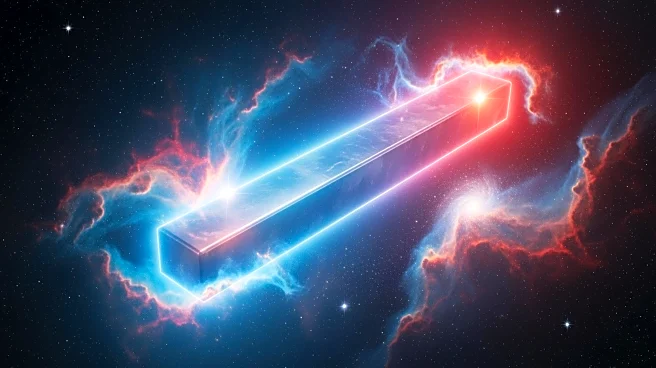
Astronomers have identified a significant iron bar within the Ring Nebula using the William Herschell Telescope and the WEAVE instrument. This discovery was made at the Observatorio del Roque de los Muchachos
in Spain. The iron bar, which extends 1,000 times the distance between Pluto and the Sun, contains an iron mass equivalent to that of Mars. The Ring Nebula, also known as Messier 57, is a planetary nebula located approximately 2,000 light-years away in the constellation Lyra. The nebula is the remnant of a sun-like star that exhausted its nuclear fuel and shed its outer layers. The discovery was published in the Monthly Notices of the Royal Astronomical Society.
Why It's Important?
The discovery of the iron bar within the Ring Nebula is significant as it challenges existing understanding of planetary nebulae and their compositions. This finding could provide insights into the processes that occur when stars like our Sun reach the end of their life cycles. Understanding the formation of such structures could also shed light on the fate of rocky planets orbiting dying stars. The presence of iron suggests complex chemical processes that may have implications for the study of other nebulae and the lifecycle of stars. This discovery highlights the capabilities of the WEAVE instrument in providing detailed spectral data, which could lead to further astronomical breakthroughs.
What's Next?
The research team plans to conduct follow-up studies using the WEAVE instrument to explore the iron bar's formation mechanism. They aim to determine whether other chemical elements coexist with the iron, which could help identify the processes involved in its creation. The team also intends to investigate whether similar structures exist in other planetary nebulae, which could provide a broader understanding of these phenomena. These studies may reveal more about the lifecycle of stars and the potential for similar occurrences in other parts of the universe.