



What's Happening?
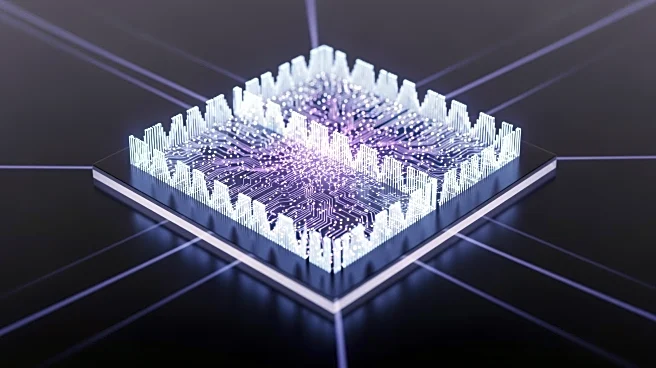
Recent developments in optical neural computing have been highlighted by the demonstration of an end-to-end partially coherent deep optical neural network (PDONN) on a silicon photonic chip. This advancement addresses key challenges in optical neural networks,
such as limited network depth and restricted input dimensions. The PDONN utilizes a monolithically integrated opto-electro-opto nonlinear activation function, enabling multiple nonlinear layers to be cascaded on a single chip. This innovation allows for deeper photonic neural architectures without the need for external electrical amplifiers. The network integrates convolutional and fully connected layers, achieving high classification accuracy for image recognition tasks. The design enhances manufacturability and robustness while maintaining energy efficiency.
Why It's Important?
The development of the PDONN represents a significant step forward in the field of optical computing, which is crucial for the future of artificial intelligence (AI). Optical computing offers high-speed processing capabilities and energy efficiency, which are essential for handling the large-scale computations required by AI applications. This technology could potentially outperform traditional electronic computing in specific domains, particularly those requiring real-time processing. The successful demonstration of the PDONN on a silicon photonic chip suggests that optical computing could become a viable alternative to electronic computing, offering a path to more efficient AI systems.
What's Next?
The next steps for optical neural computing involve further refining the technology to overcome current limitations, such as footprint constraints and cascadability issues. Researchers will likely focus on developing more energy-efficient components and improving the scalability of optical networks. As the technology matures, it could lead to broader adoption in various industries, particularly those that require high-speed data processing. Continued advancements in silicon photonics and optical computing could pave the way for new applications and innovations in AI and beyond.