



What's Happening?
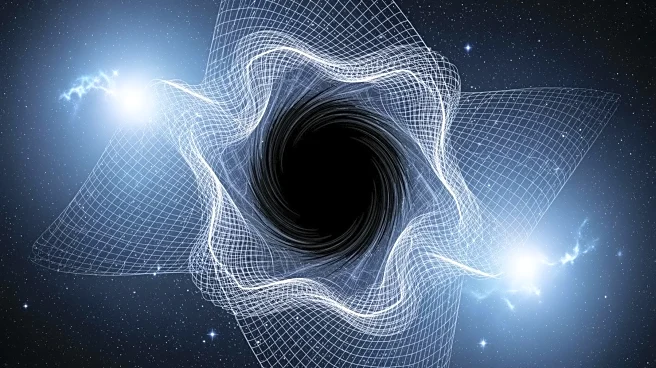
Astronomers have observed a black hole twisting spacetime, a phenomenon known as Lense-Thirring precession or frame-dragging. This effect, predicted by Einstein's theory of general relativity, involves a rotating black hole dragging the spacetime around
it, affecting nearby matter such as stars. The research, led by the National Astronomical Observatories at the Chinese Academy of Sciences with support from Cardiff University, focused on a tidal disruption event (TDE) where a star was torn apart by a supermassive black hole. The remains of the star formed a spinning disk around the black hole, launching intense jets of material. By tracking X-ray and radio signals, researchers found that the disk and jet wobbled together in a 20-day cycle, providing evidence of the frame-dragging effect.
Why It's Important?
This discovery is significant as it provides the most compelling evidence yet of Lense-Thirring precession, a key prediction of general relativity. It enhances our understanding of black hole spin, accretion physics, and jet formation. The findings offer a new method for probing black holes, which are critical to understanding the universe's structure and evolution. This research not only confirms century-old predictions but also advances our knowledge of tidal disruption events, where stars are shredded by black holes. Such insights could lead to further breakthroughs in astrophysics and cosmology, impacting how scientists study and interpret cosmic phenomena.
What's Next?
Future research will likely focus on further observations of similar events to refine our understanding of black hole dynamics. Scientists may use these findings to explore other predictions of general relativity and investigate the mechanics of black hole interactions with surrounding matter. This could involve more detailed studies using advanced telescopes and observatories to capture similar phenomena across different regions of the universe. The ongoing exploration of black holes will continue to challenge and expand our understanding of fundamental physics.