






What's Happening?
The United Nations Environment Programme (UNEP) announced significant progress in global methane emission reductions, with nations and oil and gas operators achieving cuts equivalent to removing 26 million cars from the road for a year. This announcement
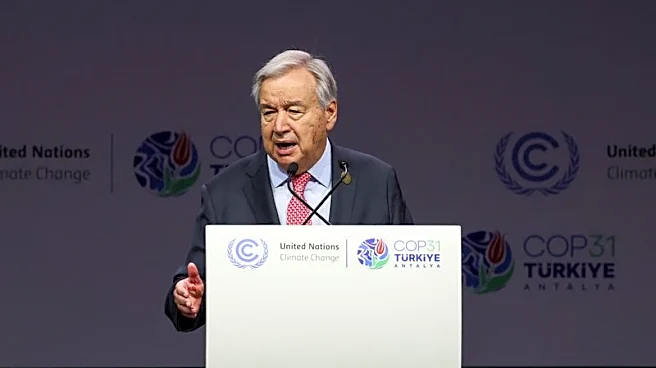
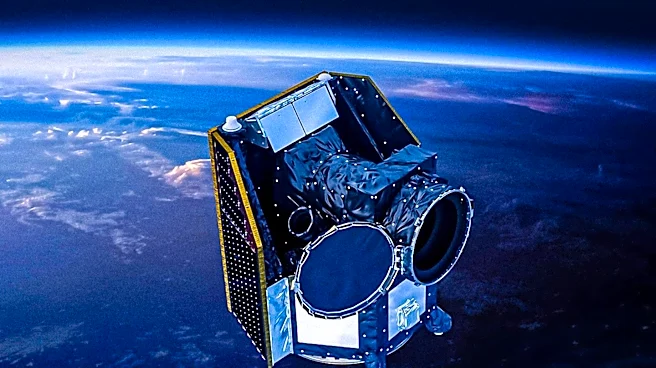
was made during COP31, where ministers also discussed increased commitments from other nations and the oil and gas industry towards methane transparency. Since June 2026, UNEP's Methane Alert and Response System (MARS), which utilizes satellites, AI, and scientific expertise, has confirmed the mitigation of five new major methane sources across Canada, Iraq, Kazakhstan, and Mexico. These new mitigations account for 125,000 tonnes of methane, equivalent to the climate impact of nearly 2.5 million cars driven for a year. The total number of methane emissions addressed through MARS has now reached the equivalent of taking 26 million cars off the road for a year. The Oil and Gas Methane Partnership 2.0, a private sector reporting framework, has expanded to 164 companies, representing 43% of global oil and gas production, with a third of this production on track for its Gold Standard in measurement-based emissions reporting.
Why It's Important?
Methane is the second-largest contributor to global heating after carbon dioxide, and its rapid reduction is crucial for slowing global warming, as it leaves the atmosphere quickly. The reported progress demonstrates that significant methane reductions are achievable and are actively taking place. This is vital for the global effort to limit the temperature rise to 1.5°C by the end of the century. The increased commitment to methane transparency from the oil and gas industry, facilitated by initiatives like the Oil and Gas Methane Partnership 2.0, is essential for establishing a credible picture of emissions. This transparency allows investors, markets, and regulators to accurately assess progress towards mitigation goals. Furthermore, the success of satellite-based monitoring systems like MARS highlights the effectiveness of advanced technology in identifying and addressing major methane leaks, providing a model for other countries and industries to adopt. The expansion of UNEP's work into coal and steel sectors for methane reduction also underscores a broader, multi-sectoral approach to climate action.
What's Next?
UNEP aims to expand support to help countries achieve an 80% response rate to major emission alerts by 2030, building on the success seen in countries like Azerbaijan, Canada, Iraq, and Libya. The continued growth of the Oil and Gas Methane Partnership 2.0 is expected to further accelerate measurement-based methane transparency and mitigation within the sector. UNEP is also expanding its methane reduction efforts to include coal and steel industries, with analysis indicating significant mitigation potential in metallurgical coal used in steel production. Kazakhstan's plan to develop a national satellite-based program for regulating methane emissions in its oil and gas sector, with support from various international partners, signals a growing trend towards integrating advanced monitoring into national regulations. This initiative could serve as a precedent for other oil and gas-producing countries, fostering stronger accountability and accelerating methane reductions globally.
Beyond the Headlines
The integration of satellite technology and artificial intelligence in methane detection and mitigation, as exemplified by MARS, represents a significant shift in environmental monitoring and enforcement. This technological advancement allows for more precise and timely identification of emission sources, moving beyond traditional reporting methods. The emphasis on transparency and data-driven action also highlights a growing demand for verifiable environmental performance from both governments and industries. The success of these initiatives could lead to a broader adoption of similar technologies for monitoring other greenhouse gases and pollutants, fundamentally changing how environmental regulations are developed and enforced. Moreover, the collaborative efforts between international organizations, governments, and the private sector underscore the understanding that climate change requires a unified, global response, transcending national borders and sectoral divides.