
What's Happening?
Archaeologists in Italy have discovered an Etruscan ritual well near the ancient city of Kainua, close to modern-day Bologna. The well, dating back to the late sixth or early fifth century B.C., was found near a sanctuary dedicated to the mother-goddess
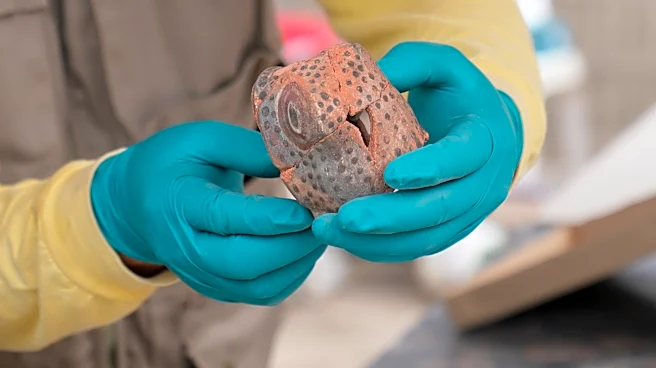
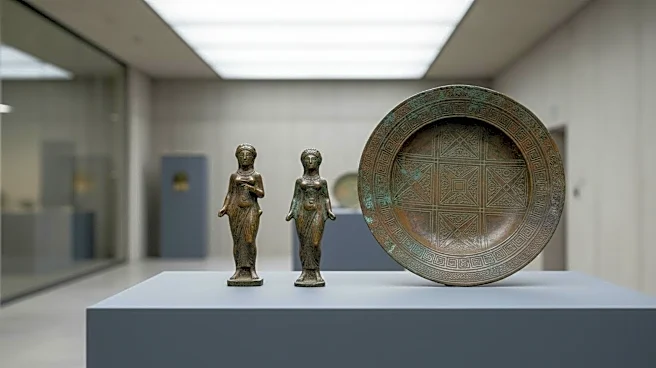
Uni, the Etruscan equivalent of Juno. Inside the well, researchers unearthed a unique bronze plate and fragmented remains of two bronze female statuettes, which still retained their luster due to the low-oxygen underwater environment. These artifacts are believed to be part of an 'opening ritual' for the well, possibly celebrating the 'birth' of the ancient city. Additionally, the skeletons of a man and a woman were found, suggesting a 'ritual closing' of the well, though preliminary investigations indicate they were not victims of human sacrifice.
Why It's Important?
This discovery offers significant insights into the religious practices, cultural beliefs, and societal structure of the ancient Etruscans, a civilization that heavily influenced early Roman culture. The presence of precious bronze objects and human remains in a ritual context provides a rare glimpse into their complex ceremonies related to water, fertility, and the founding of cities. The association with the goddess Uni, who was linked to women, marriage, birth, and growth, underscores the importance of female deities and agricultural fertility in Etruscan society. Understanding these rituals helps historians and archaeologists reconstruct the daily lives and spiritual world of this ancient civilization, enriching our knowledge of pre-Roman Italy.
What's Next?
Further studies will be conducted on the human remains found in the well, beginning in September. DNA analysis and carbon-14 dating are expected to provide more information about the individuals' identities and the precise chronology of the well's use. Researchers will also continue to analyze the bronze artifacts and their context to gain a deeper understanding of the specific rituals performed. The findings will contribute to ongoing research into Etruscan culture, particularly their water cults and the role of goddesses like Uni. This excavation may also lead to further explorations in the area, potentially uncovering more evidence of Etruscan religious and civic life.
Beyond the Headlines
The discovery highlights the profound symbolic significance of natural elements, particularly water, in ancient cultures. The Etruscans' belief in the 'regenerative' quality of bronze, linking its production to birth and Uni's domain, reveals a sophisticated understanding of materials and their spiritual connections. This intertwining of material culture, religious belief, and civic life offers a powerful lens through which to view ancient societies. It also underscores the enduring human need for ritual and meaning-making in relation to fundamental aspects of existence, such as life, death, and the sustenance provided by nature. The well serves as a tangible link to a past where the sacred and the mundane were deeply integrated, offering lessons on humanity's historical relationship with its environment and spiritual world.