
What's Happening?
Super-Earths, planets larger than Earth but smaller than ice giants like Neptune, are among the most common types of planets in our galaxy. These planets, which can be composed of rock, gas, water, or
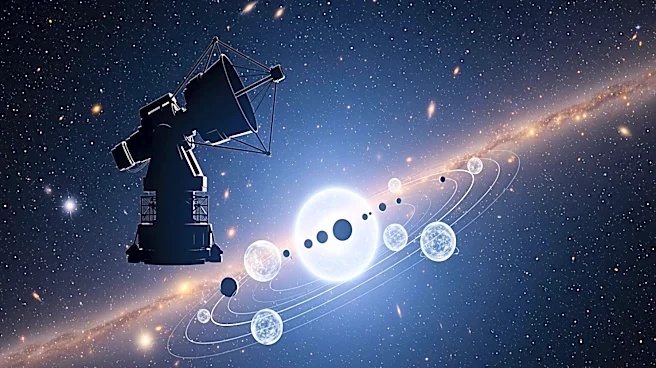
a combination, have been discovered in abundance over the past 30 years. Despite their name, Super-Earths do not necessarily resemble Earth in terms of surface or atmosphere. The discovery of these planets has prompted scientists to reconsider theories of planetary formation and the potential for life beyond Earth. Recent advancements in detection methods, such as gravitational microlensing, have revealed that Super-Earths may be more prevalent than previously thought, even in distant orbits.
Why It's Important?
The study of Super-Earths is reshaping scientific understanding of planetary systems and the conditions necessary for life. These discoveries challenge existing models of planet formation, particularly regarding the transition from rocky to gas planets. The prevalence of Super-Earths suggests that our solar system's configuration may be atypical, prompting a reevaluation of the factors that contribute to planetary diversity. This research has significant implications for the search for extraterrestrial life, as it expands the range of environments where life might exist. The findings also highlight the importance of developing new technologies and methods for detecting and studying distant planets.