







What's Happening?
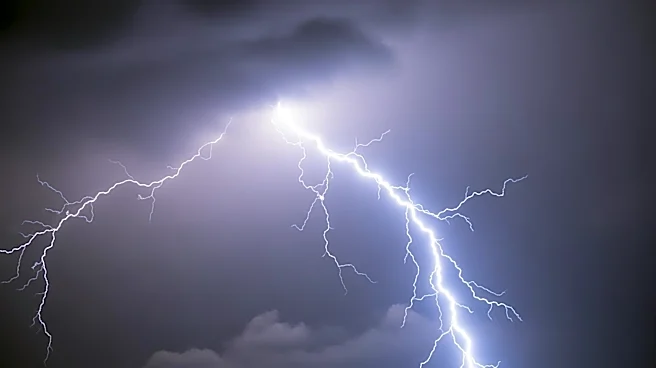
The US National Oceanic and Atmospheric Administration (NOAA) reports that a lightning channel can reach temperatures of about 30,000 degrees Celsius, roughly five times hotter than the Sun's surface. This rapid heating causes the air to expand violently,
creating thunder. The temperature is derived from the light emitted by the lightning channel, similar to how astronomers measure the Sun's surface temperature. Despite its high temperature, lightning is not more energetic than the Sun, as it occurs in a small, brief channel compared to the Sun's vast, continuous energy output.
Why It's Important?
Understanding the physics of lightning and thunder is crucial for meteorology and safety. The extreme temperatures and rapid expansion of air during a lightning strike can have significant implications for weather patterns and storm intensity. This knowledge aids in improving weather prediction models and developing better safety protocols during thunderstorms. Additionally, the comparison between lightning and the Sun's surface temperature provides insight into the energy dynamics of natural phenomena, enhancing scientific understanding of atmospheric processes.