






What's Happening?
A recent report by the California Initiative for Technology and Democracy (CITED), a project of the nonpartisan watchdog Common Cause, indicates that AI chatbots from major firms can provide inaccurate information regarding the upcoming California election.
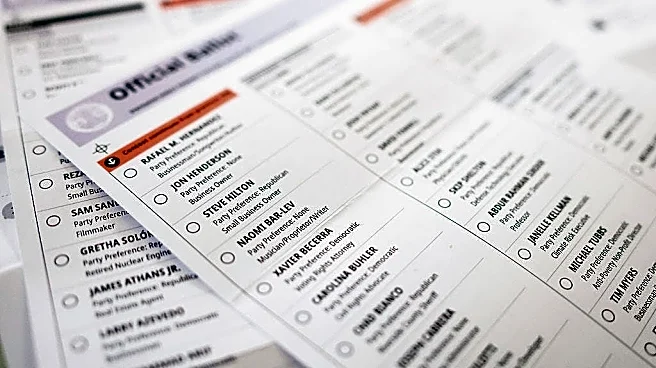
The analysis, released on Monday, tested several prominent AI chatbots with identical prompts concerning California ballot measures and candidates for governor and Los Angeles mayor. While the chatbots were often accurate, they also produced basic errors and, in some instances, exhibited potential bias. For example, Anthropic’s chatbot, Claude, incorrectly stated that Nithya Raman lost the primary race for Los Angeles mayor, when she had, in fact, advanced to the general election. Additionally, chatbots frequently directed users to incorrect propositions when asked about 2026 statewide ballot measures, sometimes referencing measures from prior years or other states like Michigan. John Bennett, director of CITED, highlighted the danger of these systems producing confident but untrue responses, potentially lulling voters into a false sense of security.
Why It's Important?
The findings of this report are significant as they underscore the potential for AI chatbots to influence public discourse and voter decisions, particularly in critical electoral processes. The spread of misinformation, even if unintentional or infrequent, can erode trust in information sources and lead to misinformed voting. As AI technology becomes more integrated into daily life, its role in political information dissemination raises concerns about the integrity of elections and the democratic process. The report suggests that while AI companies claim errors are a small fraction of responses and that systems are constantly improving, the unpredictable nature of these inaccuracies poses a substantial risk. Voters relying on these tools for election research may be inadvertently misled, impacting their understanding of candidates, propositions, and the overall political landscape. This issue is particularly pertinent given the growing national anxiety about the risks associated with AI technology.
What's Next?
In response to these findings, voters are advised to approach interactions with chatbots, especially concerning elections, with a critical mindset and to verify information from multiple sources. AI companies are likely to face increased scrutiny and pressure to enhance the accuracy and reliability of their chatbots, particularly in sensitive areas like election information. While OpenAI has stated ongoing efforts to improve the quality of election-related information and provide source links, the report highlights that more robust solutions are needed. Regulatory bodies and policymakers may also consider these findings as they deliberate on guidelines and regulations for AI use in public information and political contexts. The ongoing challenge will be to balance the utility of AI tools with the imperative to prevent the spread of misinformation, ensuring that citizens have access to accurate and unbiased information to make informed decisions.
Beyond the Headlines
The report's implications extend beyond immediate election concerns, touching upon broader issues of digital literacy and the evolving nature of truth in the age of artificial intelligence. The phenomenon of chatbots producing 'confident but not true' responses highlights a fundamental challenge in human-AI interaction: the tendency to trust authoritative-sounding information without critical evaluation. This 'cognitive offloading,' where individuals defer their thought processes to AI, could have long-term effects on critical thinking skills and information discernment. Furthermore, the potential for AI models to exhibit subtle biases, even if not explicitly programmed, raises ethical questions about the development and deployment of these technologies. As AI becomes more pervasive, understanding and mitigating these deeper implications will be crucial for maintaining an informed populace and a healthy democratic society, necessitating a collaborative effort from tech developers, educators, and policymakers.