




What's Happening?
Thales has launched its HexaForce next-generation AI-enhanced multi-domain command and control (C2) system. This system is designed to support national sovereignty and provide a rapid response to the increasing volume of operational data and the accelerating
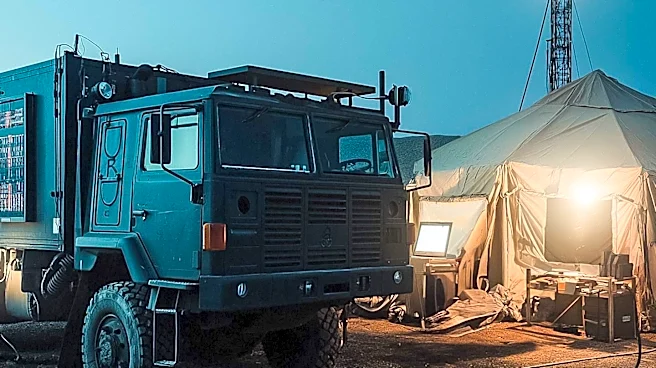
pace of conflicts. HexaForce aims to shorten planning cycles, enrich operational picture awareness, and facilitate real-time sharing of tactical and operational situational pictures. It also seeks to accelerate decision-making, enhance effector allocation, and optimize in-the-field maintenance and support. The system operates across all operational domains, including land, air, sea, cyber, electromagnetic spectrum, space, and information operations. It features a resilient, distributed architecture that orchestrates existing systems across national armed forces and coalitions to secure operational advantage at every command level. HexaForce integrates artificial intelligence capabilities from cortAIx, Thales’ dedicated AI accelerator, which involves 800 engineers and data scientists working with defense experts. By incorporating cutting-edge Large Language Models (LLMs) and agentic AI, HexaForce provides significant benefits for operators throughout mission phases.
Why It's Important?
The introduction of the HexaForce C2 system is important for U.S. and allied nations as it addresses the growing complexities of modern warfare and the need for rapid, data-driven decision-making. In an era of high-intensity conflicts and massive operational data, the ability to process, analyze, and act upon information quickly is crucial for maintaining a strategic advantage. This system's multi-domain capabilities mean that it can integrate and coordinate operations across various environments, from traditional land and sea to cyber and space, which is essential for comprehensive defense strategies. The use of advanced AI, including LLMs, allows for the automation of data analysis, correlation, and prioritization, significantly boosting military agility and tempo. This enhanced operational intelligence can lead to more effective resource allocation and improved mission outcomes, directly impacting the security and defense posture of the U.S. and its allies. The system's open-source standards and interoperable architecture also allow for integration with existing technologies, promoting collaboration and efficiency among coalition partners.
What's Next?
Live trial phases for the HexaForce system are currently underway, with the goal of increasing its capacity from processing 100 to 1,000 targets per day. This expansion in processing capability will pave the way for full-scale deployment. The system's development has leveraged operational feedback from Artemis.IA, a data-centric platform deployed with the French Ministry of Armed Forces since 2023, which has demonstrated its effectiveness in multi-source data processing and AI scaling. HexaForce is designed to be the only market solution capable of orchestrating all assets across armed forces and coalition partners, from strategic commanders to tactical units. Its reliance on a distributed data network ensures resilience even under severely degraded communications conditions. The system's open and interoperable architecture, rigorously tested during exercises like NATO CWIX 2026, ensures full sovereign control over data feeds without requiring data exposure. Future developments will likely focus on further integrating chosen technology partners within its controlled, modular environment to maximize operational performance and national sovereignty.
Beyond the Headlines
The HexaForce C2 system represents a significant shift towards AI-driven defense strategies, highlighting the increasing reliance on artificial intelligence for national security. The ethical implications of AI in military decision-making, particularly concerning autonomous systems and data interpretation, will become more prominent. The system's emphasis on 'sovereign control' over data feeds underscores a broader geopolitical trend where nations seek to maintain independence and security in their digital defense infrastructure, rather than relying on proprietary foreign systems. This could lead to increased investment in domestic AI and cybersecurity capabilities among allied nations. Furthermore, the integration of advanced AI, such as Large Language Models, into military command structures raises questions about the future of human-machine collaboration in warfare and the potential for AI to influence strategic and tactical decisions. The system's ability to operate across multiple domains also suggests a future where conflicts are increasingly hybrid, requiring integrated responses across physical and digital battlefields.