




What's Happening?
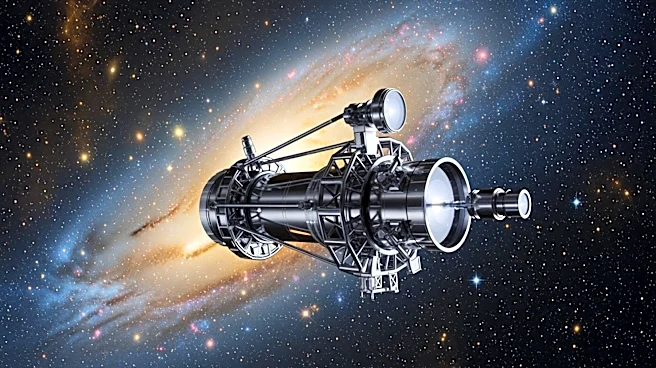
A collaboration between the James Webb Space Telescope and the Hubble Space Telescope has provided new insights into how young star clusters influence galaxy formation. Researchers analyzed nearly 9,000 young star clusters in four neighboring galaxies,
revealing that the most massive clusters clear away surrounding gas faster than previously thought. This process, known as stellar feedback, affects how galaxies form new stars and even how planets form nearby. The study, part of the FEAST program, highlights the role of intense ultraviolet radiation and stellar winds in dispersing gas clouds, which impacts the availability of cold gas for future star formation.
Why It's Important?
The findings are significant as they challenge previous models of star and planet formation. The rapid clearing of gas by massive star clusters limits the raw material available for new stars, potentially altering the star formation rate within galaxies. This has implications for our understanding of galaxy evolution and the conditions necessary for planet formation. The study suggests that young planetary systems in dense clusters may not have enough time to accumulate sufficient mass, affecting the development of planets. These insights could lead to a reevaluation of how galaxies and planetary systems evolve over time.
What's Next?
Further research will likely focus on refining models of stellar feedback and its impact on galaxy and planet formation. The data from the James Webb and Hubble telescopes provide a foundation for future studies aimed at understanding the complex interactions between young stars and their environments. This could lead to new theories about the formation and evolution of galaxies and planetary systems, enhancing our knowledge of the universe's structure and dynamics.