







What's Happening?
A collaboration between Aerkomm Inc., Foxconn-linked GTOC Tactical Technology, and San Diego's Firestorm Labs aims to establish a 'non-red,' China-free drone supply chain in Taiwan. This initiative follows an incident on January 17, 2026, where a Chinese
WZ-7 'Soaring Dragon' drone entered Taiwan-controlled airspace, highlighting a gap in Taiwan's air defense capabilities. The partnership seeks to build local capacity for rapid drone production, integrating Firestorm's 3D-printing technology with Taiwanese manufacturing. Vice President Hsiao Bi-khim has emphasized that all government drone production and procurement, both military and civilian, should adhere to a fully 'non-red' supply chain due to geopolitical and cybersecurity concerns. Taiwan plans to invest NT$44.2 billion (US$1.38 billion) over five years to expand its domestic UAV sector, with a goal of producing 180,000 units annually by 2028, free of Chinese components. This push is driven by the need for deterrence and 'peace through strength' amidst heightened cross-strait tensions.
Why It's Important?
This partnership is crucial for U.S. national security and its Indo-Pacific strategy, as it directly addresses the growing military imbalance in the region, particularly concerning China's expanding naval power. By fostering a robust, China-free drone manufacturing capability in Taiwan, the U.S. and its allies aim to enhance Taiwan's self-defense, reduce its reliance on vulnerable overseas supply chains, and strengthen regional stability. The ability to rapidly produce drones locally, as demonstrated by Firestorm Labs' 'microfactory' concept, offers significant operational and defensive advantages, allowing for quicker deployment and repair of critical assets without relying on distant supply lines. This initiative also serves as a model for other nations seeking to secure their defense supply chains from potential adversary influence, aligning with broader U.S. efforts to counter China's technological and military advancements. The development of 'non-red' supply chains is vital for maintaining technological superiority and preventing adversaries from embedding 'kill switches' in critical infrastructure.
What's Next?
The immediate next steps involve the implementation of the framework agreement, focusing on integrating Firestorm's 3D-printing technology into GTOC Tactical Technology's manufacturing processes in Taiwan. This will include developing aerospace- and military-grade glass 'conformal' antennas and establishing a distributed defense-manufacturing model. Taiwan's government will continue to invest in its domestic UAV sector, with ongoing efforts to ensure all drone production and procurement meet the 'non-red' standard. Legislative support for the defense budget, particularly for drone-related initiatives, will be critical to avoid slowing the sector's development. The U.S. will likely continue to support such partnerships, potentially expanding cooperation in other strategic technologies to bolster regional security and maintain its technological edge. The success of this venture could lead to similar collaborations in other critical areas, further solidifying a secure, allied-centric supply chain in the Indo-Pacific.
Beyond the Headlines
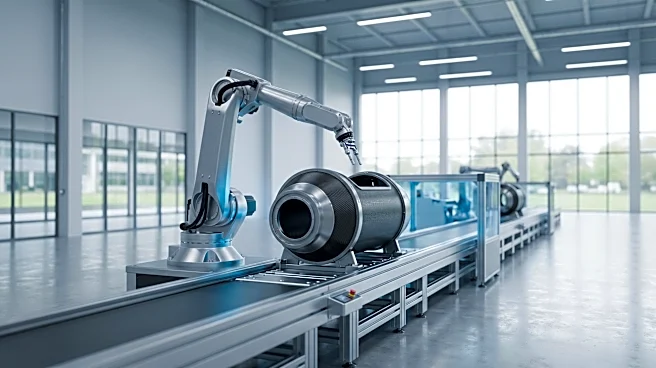
The deeper implications of this initiative extend to the broader geopolitical landscape, signaling a strategic shift towards decoupling critical defense technologies from potential adversaries. This move highlights the increasing recognition that economic interdependence can become a national security vulnerability. The concept of a 'microfactory' capable of on-site production, as championed by Firestorm Labs, could revolutionize military logistics and supply chain resilience, enabling forces to produce essential components and systems closer to the point of need, even in contested environments. This also raises ethical considerations regarding the proliferation of drone technology and the potential for autonomous weapons systems. Furthermore, the emphasis on 'non-red' supply chains underscores a growing global trend towards trusted partnerships and the re-industrialization of strategic sectors, aiming to safeguard intellectual property and prevent espionage in an increasingly complex technological arms race.