









What's Happening?
On September 23, 1999, NASA's Mars Climate Orbiter was lost during its Mars orbital insertion maneuver due to a critical error involving unit conversion. The spacecraft fired its main engine to enter orbit around Mars, but its signal was lost approximately
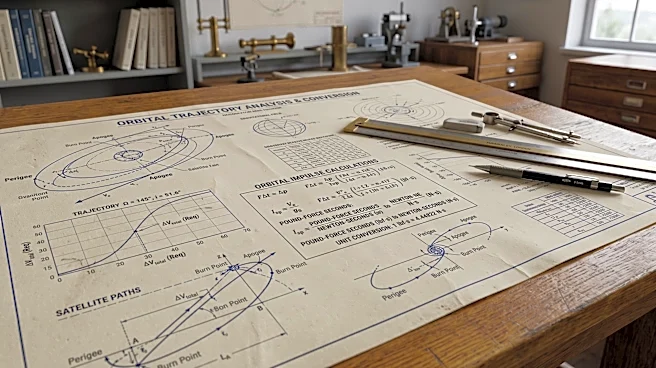
four minutes later as it passed behind the planet, and communication was never re-established. Investigations revealed that the root cause of the failure was a mix-up between English and metric units in the mission's navigation software. Specifically, ground software reported thruster data in pound-force seconds (English units), while the navigation software expected newton-seconds (metric units). This discrepancy led to significant miscalculations in the spacecraft's trajectory. As a result, navigation estimates placed the probe at an altitude of about 35 miles (57 kilometers) above the Martian surface, far below its planned path, which was intended to be around 140 miles (226 kilometers) for the initial pass. The orbiter was either destroyed upon entering the Martian atmosphere at too low an altitude or re-entered heliocentric space after exiting the atmosphere.
Why It's Important?
The loss of the Mars Climate Orbiter due to a simple unit conversion error represents a significant setback for NASA and the scientific community, costing $193.1 million for spacecraft development and an additional $91.7 million for launch. This incident highlighted critical flaws in NASA's systems engineering, communication protocols, and quality control processes. Dr. Edward Weiler, then NASA's associate administrator for space science, emphasized that the problem was not merely the error itself but the failure of the systems designed to detect and correct such mistakes. The orbiter was intended to study Martian weather and climate, including dust storms and water vapor, and to relay communications for the Mars Polar Lander mission. Its loss severely impacted these scientific objectives and the overall Mars exploration program at the time. The event served as a stark reminder of the absolute necessity for meticulous attention to detail, rigorous cross-checking, and robust communication across all teams involved in complex space missions.
What's Next?
Following the loss of the Mars Climate Orbiter, NASA undertook extensive reviews and implemented significant changes to its mission development and operational procedures. These changes focused on enhancing systems engineering, improving communication between different project groups and contractors, strengthening training protocols, and implementing more comprehensive testing to catch such errors. The incident led to a renewed emphasis on standardized units and rigorous verification processes for all data interfaces in subsequent missions. While the immediate impact was the loss of scientific data and financial resources, the long-term consequence was a more robust and error-averse approach to mission planning and execution within NASA. Future missions would incorporate lessons learned to prevent similar catastrophic failures, ensuring that all software and hardware components adhere to consistent unit standards.
Beyond the Headlines
The Mars Climate Orbiter incident transcended a mere technical failure; it became a case study in organizational psychology and the critical importance of interdisciplinary communication in high-stakes environments. The error was not a single individual's mistake but a systemic breakdown involving multiple teams and their interfaces. The navigation team was not fully familiar with the spacecraft's attitude operations, communication among project groups was weak, staffing was thin, and training had gaps. This event underscored that even in highly advanced technological endeavors, human factors, organizational structure, and communication effectiveness are paramount. It led to a cultural shift within NASA, promoting a more integrated approach to mission management where every detail, no matter how seemingly minor, is thoroughly vetted across all relevant teams. The incident remains a cautionary tale in engineering and project management, frequently cited in discussions about quality assurance, risk management, and the perils of assumptions in complex systems.