


What's Happening?
A new USA Today/Suffolk University poll in Ohio indicates that Sherrod Brown (D) is leading Jon Husted (R) in the U.S. Senate race. The poll shows Brown with 47% support, while Husted trails with 44%. Two other candidates, Bill Redpath (L) and Greg Levy
(I), garnered 2% and 1% respectively. This survey reflects the current standing of the candidates among likely voters in Ohio, with a margin of error of ±4.4%. The results suggest a close contest, but with Brown currently holding a slight advantage. This poll provides a snapshot of voter sentiment in a key Senate race that could impact the balance of power in the U.S. Senate.
Why It's Important?
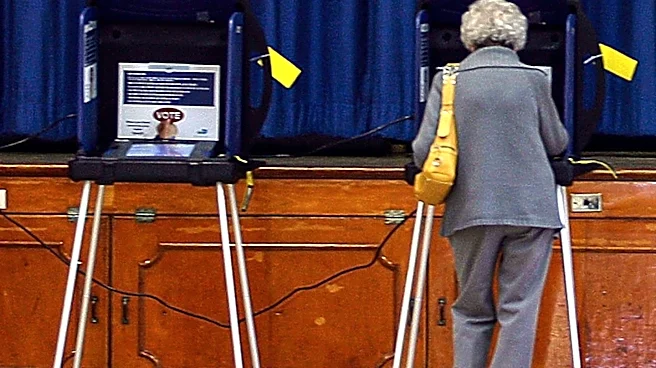
The lead held by Sherrod Brown in the Ohio Senate race, as reported by the USA Today/Suffolk University poll, is significant for the Democratic Party's efforts to maintain or expand its presence in the U.S. Senate. Ohio is often considered a bellwether state, and a victory for Brown would demonstrate the Democratic Party's ability to win in competitive, traditionally swing states. This outcome could influence national political narratives and strategies for upcoming elections. For the Republican Party, a loss in Ohio would be a setback, potentially narrowing their path to a Senate majority or weakening an existing one. The close margin also highlights the importance of voter turnout and campaign efforts in the final weeks leading up to the election. The performance of third-party and independent candidates, though small, could also play a role in the final outcome by drawing votes away from the major party candidates.
What's Next?
As the Ohio Senate race progresses, both Sherrod Brown and Jon Husted will likely intensify their campaign activities, focusing on voter outreach and messaging to secure a victory. Given the narrow lead indicated by the USA Today/Suffolk University poll, both campaigns will be working to mobilize their base supporters and persuade undecided voters. We can expect to see increased advertising, campaign rallies, and public appearances from both candidates. The role of external political action committees and national party organizations will also likely grow, providing financial and strategic support. Future polls will be closely watched to see if Brown can maintain his lead or if Husted can close the gap. The outcome of this race will be a key indicator of the political climate and could have immediate implications for the legislative agenda in the U.S. Senate.
Beyond the Headlines
The Ohio Senate race, with its tight margins, underscores the persistent political polarization within the United States, even in states that have shown a tendency to lean one way or another in recent national elections. Sherrod Brown's continued competitiveness in Ohio, despite the state's recent Republican presidential leanings, highlights the potential for individual candidate strength and local issues to transcend national partisan divides. This race could serve as a case study for political strategists on the effectiveness of different campaign approaches in a highly contested environment. Furthermore, the presence of third-party and independent candidates, even with low polling numbers, reflects a segment of the electorate that may be dissatisfied with the major parties, potentially influencing the final vote distribution in a close election. The dynamics of this race will offer insights into voter behavior and the evolving political landscape in the Midwest.