








What's Happening?
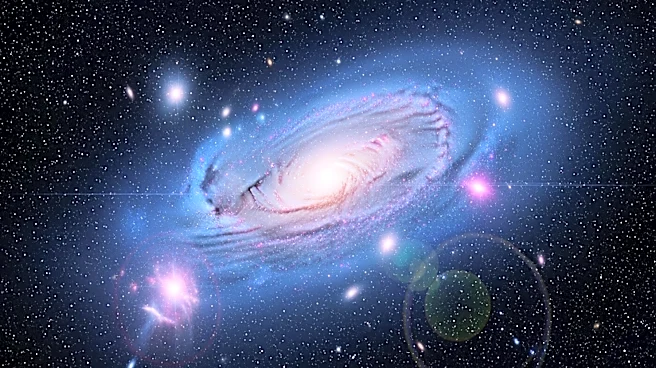
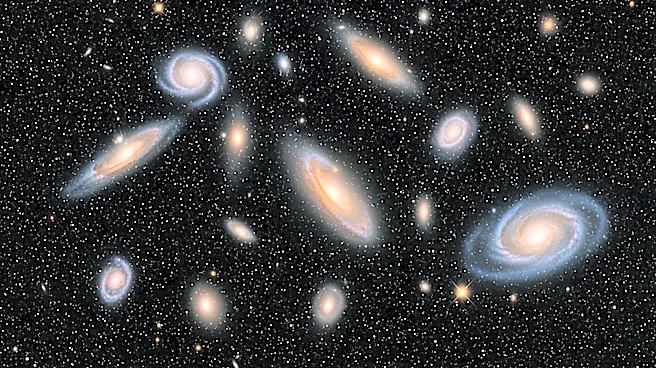
Astronomers have identified a potential new example of galaxies that appear to contain little or no dark matter. The galaxies, FCC 224 and FCC 240, located on the outskirts of the Fornax Cluster, share unusual traits with previously known dark-matter-deficient
galaxies, NGC 1052-DF2 and NGC 1052-DF4. These ultra-diffuse galaxies are roughly the size of the Milky Way but have significantly less mass and fewer stars. The study, led by Maria Luísa Buzzo of Yale University, utilized the MUSE instrument on the Very Large Telescope to explore these galaxies. The research suggests that a high-speed collision between dwarf galaxies could separate stars from their dark matter, leading to the formation of these unique systems. The findings were published on the arXiv preprint server.
Why It's Important?
The discovery of dark matter-deficient galaxies challenges existing theories about galaxy formation and the role of dark matter in the universe. Understanding these galaxies could provide insights into the nature of dark matter and its distribution. The research also highlights the potential for high-velocity collisions to influence galaxy evolution, offering a new perspective on cosmic events. This could impact future studies in astrophysics and cosmology, as scientists seek to unravel the mysteries of dark matter and its influence on the universe's structure.
What's Next?
Further research is needed to confirm whether FCC 224 and FCC 240 are indeed dark matter-deficient and to understand the processes that led to their formation. Astronomers may conduct deeper and more comprehensive observations to search for additional fragments or ejected dark matter halos. These studies could help determine if the phenomenon observed in the Fornax Cluster is unique or part of a broader cosmic pattern. The findings may also prompt a reevaluation of current models of galaxy formation and dark matter distribution.