






What's Happening?
Astronomers from the University of Oxford and the Max Planck Institute for Gravitational Physics have developed a new strategy to identify tightly bound pairs of supermassive black holes, which are expected to form after galaxies merge. These pairs, known
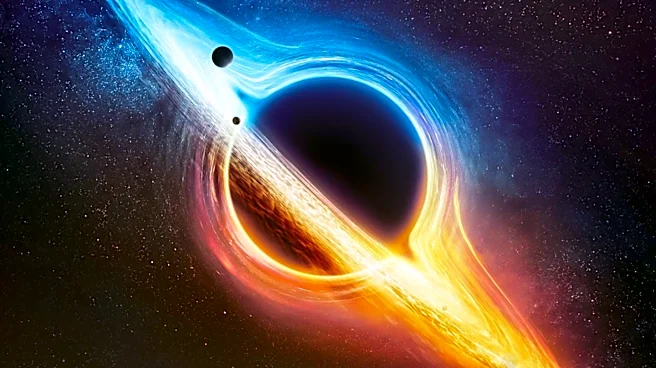
as supermassive black hole binaries, are difficult to detect due to their close proximity. The researchers suggest that the immense gravity of these black holes could magnify the light from stars behind them, creating recurring flashes that may reveal their presence. This phenomenon, known as gravitational lensing, could be observed through existing and upcoming sky surveys, potentially identifying these binaries before future space-based gravitational wave observatories come online.
Why It's Important?
The discovery of supermassive black hole binaries is crucial for understanding galaxy evolution and the generation of gravitational waves, some of the strongest in the universe. Detecting these binaries could provide insights into the masses and orbits of black holes, enhancing our understanding of gravitational physics. The ability to identify these systems through visible light effects, rather than waiting for gravitational wave detectors, could accelerate research in this field. This approach opens new avenues for multi-messenger astronomy, allowing scientists to study black holes using both electromagnetic and gravitational signals.
What's Next?
Future observatories like the Vera C. Rubin Observatory and the Nancy Grace Roman Space Telescope are expected to expand the search for these repeating lensing events. As these facilities come online, they will enhance the ability to detect and study supermassive black hole binaries. This could lead to significant advancements in our understanding of black hole physics and the testing of general relativity. The research community anticipates that these developments will provide a deeper understanding of the universe's structure and the role of black holes in cosmic evolution.