






What's Happening?
Tom Burick, a technology instructor at PS Academy in Gilbert, Arizona, has led a group of students in constructing a full-scale replica of the Electronic Numerical Integrator and Computer (ENIAC). This project was initiated at the start of the 2025-2026
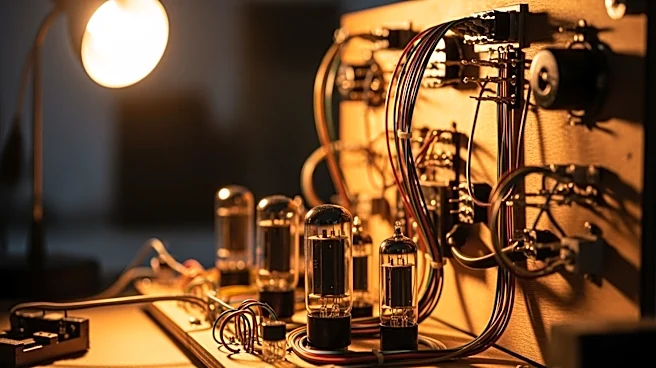
school year to commemorate the 80th anniversary of ENIAC, one of the world's first programmable electronic computers. Burick, who previously owned a robotics company, transitioned to teaching after a financial downturn. His passion for technology and robotics has been a driving force in his career, and he aims to inspire his students, many of whom have autism and other specialized learning needs. The replica project involved constructing 40 large metal panels and installing 18,000 simulated vacuum tubes, using nearly 300 square meters of cardboard and other materials. This initiative not only educates students about historical technology but also leverages their unique abilities, such as hyperfocus and precision.
Why It's Important?
The construction of the ENIAC replica serves as an educational tool that bridges historical technology with modern learning, particularly for students with autism. This project highlights the potential of neurodiverse individuals in STEM fields, showcasing how their unique skills can be harnessed in complex tasks. By engaging in such hands-on projects, students gain practical experience and confidence, which can be pivotal in their future careers. Additionally, this initiative underscores the importance of inclusive education and the role of educators in fostering environments where diverse talents are recognized and nurtured. The project also serves as a reminder of the historical significance of ENIAC in the evolution of computing, providing a tangible connection to the past for the current generation.
What's Next?
Following the success of the ENIAC replica, Tom Burick plans to continue engaging his students in similar large-scale projects. Potential future endeavors may include recreations related to the Apollo moon missions, further expanding the students' exposure to significant historical technological achievements. These projects are expected to continue fostering a passion for technology and innovation among the students, while also providing them with valuable skills and experiences that could influence their career paths. The ongoing commitment to such educational initiatives highlights the potential for similar programs to be implemented in other educational settings, promoting the integration of historical and practical learning in STEM education.
Beyond the Headlines
The ENIAC replica project also touches on broader themes of mentorship and the impact of educators in shaping the lives of their students. Tom Burick's journey from a robotics entrepreneur to a teacher reflects the transformative power of mentorship, as he seeks to 'pay it forward' by inspiring the next generation. This narrative emphasizes the importance of role models in education, particularly for students who may face additional challenges due to neurodiversity. Furthermore, the project illustrates how historical technology can be used as a tool for engagement and learning, providing students with a deeper understanding of the technological advancements that have shaped the modern world.