


What's Happening?
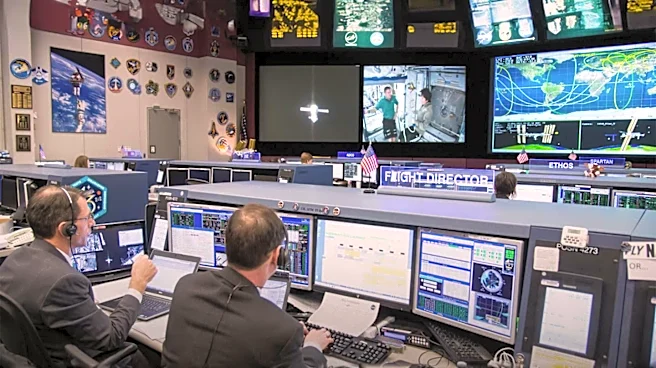
NASA astronaut Anil Menon and CSA (Canadian Space Agency) astronaut Joshua Kutryk successfully completed a spacewalk outside the International Space Station (ISS) to install a new roll-out solar array. The spacewalk, lasting 7 hours and 11 minutes, saw
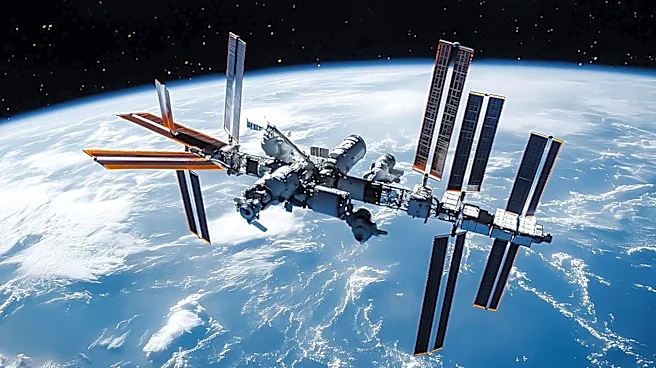
the installation and deployment of an International Space Station Roll-Out Solar Array (IROSA) on the station’s 2A electrical power channel. This array is the seventh IROSA to be installed on the ISS, contributing to the station's power capabilities. The astronauts also performed preparatory tasks for an upcoming spacewalk scheduled for November 5, during which the eighth and final IROSA will be installed on the 3B power channel. This spacewalk marked Menon's fourth and Kutryk's first, and it was the 285th spacewalk in support of the space station's assembly, maintenance, and upgrades.
Why It's Important?
The installation of this new solar array is crucial for the International Space Station's continued operations and future endeavors. The additional power provided by the IROSA will support critical functions, including a safe and controlled deorbit of the station. Once all eight roll-out solar arrays are fully installed, the station's power generation capacity will increase significantly, from 160 kilowatts to approximately 215 kilowatts, representing a 30% boost. This enhanced power supply is vital for sustaining ongoing scientific research, maintaining life support systems, and powering new experiments and technologies aboard the ISS. The successful completion of these spacewalks underscores the ongoing international collaboration in space exploration and the continuous effort to maintain and upgrade the orbiting laboratory.
What's Next?
Following the successful installation of the seventh IROSA, the next step involves the installation of the eighth and final IROSA on the 3B power channel during a planned spacewalk on November 5. NASA will provide live coverage of this event. Once this final array is installed, the augmentation of the space station's power system will be complete, significantly increasing its overall power generation capacity. This completion will allow the ISS to operate with greater efficiency and support more demanding power requirements for its various missions and experiments. The ongoing maintenance and upgrades, such as these solar array installations, are essential for extending the operational lifespan of the ISS and maximizing its scientific output.
Beyond the Headlines
The continuous upgrades to the International Space Station's power infrastructure, such as the installation of these advanced roll-out solar arrays, highlight a broader trend in space exploration towards sustainability and long-term operational capability. These technological advancements not only ensure the longevity of current missions but also pave the way for future deep-space endeavors, which will require robust and reliable power systems. The collaboration between NASA and the Canadian Space Agency on these spacewalks also underscores the importance of international partnerships in advancing human presence in space. Such joint efforts are critical for sharing resources, expertise, and the financial burden of complex space missions, ultimately fostering a more collaborative and ambitious future for space exploration.