





What's Happening?
China's Long March rocket series continues to advance its space exploration goals, drawing inspiration from the historic military trek of the Red Army. The year 2026 marks the 90th anniversary of the victory of the Long March, an epic expedition from 1934
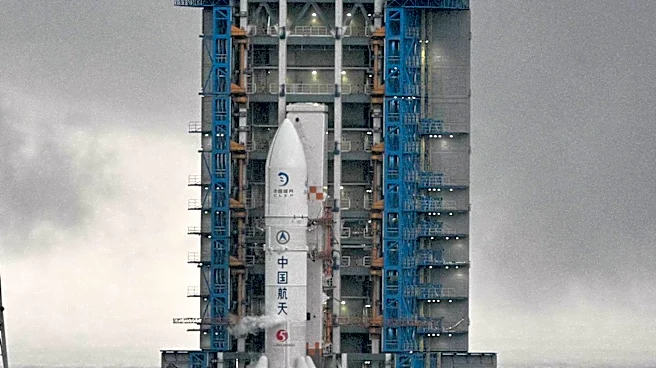
to 1936 that laid the foundation for the Chinese revolution. The rockets, named 'Long March' in 1966 by pioneering scientist Qian Xuesen, symbolize overcoming difficulties to achieve victory. On October 10, a Long March-12 rocket successfully placed the 27th batch of low-Earth orbit internet satellites into orbit, marking the 671st launch for the Long March family. Since its first launch on April 24, 1970, the series has evolved significantly, from carrying single satellites to deploying 41 in one mission, expanding its launch capabilities, and progressing towards reusable designs. These advancements are seen as a continuation of the 'Long March' spirit, enabling China's space program to break through external restrictions and achieve self-reliance in space technology, including crewed missions, navigation satellite constellations, lunar and Mars exploration, and space station construction.
Why It's Important?
The Long March rocket program is central to China's ambitions in space, reflecting its pursuit of technological self-reliance and global leadership in space exploration. The continuous evolution of these rockets, from increased payload capacity to the development of reusable designs, signifies China's growing capabilities and its commitment to a sustainable space program. This progress allows China to independently pursue its strategic objectives in space, such as building its own space station and developing advanced navigation systems like BeiDou, reducing reliance on other nations. The symbolic connection to the historic Long March reinforces a narrative of perseverance and overcoming adversity, which is a powerful message both domestically and internationally. As China prepares for more demanding phases of space development, including more frequent launches and heavier payloads, the Long March series is critical for achieving these ambitious goals and shaping the future of global space activities.
What's Next?
China's space program is entering a more demanding phase, requiring future Long March rockets to be larger, more capable, and support more frequent launches and heavier payloads. The focus will be on developing reusable, heavier, and more advanced models to meet these new demands. Recent missions, such as the maiden flight of a Long March-12B from a commercial launch pad and the successful first-stage recovery of a Long March 10B carrier rocket using a net-based capture system, indicate the direction of future development. These innovations aim to enhance performance, safety, efficiency, and reduce costs, particularly for commercial demands like deploying large internet constellations. The journey ahead involves continuous technological breakthroughs to support China's expanding plans in space, including further planetary exploration and deeper ventures into the universe, which China views as a 'Long March for all humanity.'
Beyond the Headlines
The Long March rocket program represents more than just technological advancement; it embodies China's national narrative of resilience, self-sufficiency, and ambition on the global stage. By linking its space endeavors to a pivotal moment in its revolutionary history, China projects an image of unwavering determination and capacity to overcome challenges, both internal and external. This narrative is crucial for fostering national pride and unity, as well as for signaling its growing influence in critical technological domains. The pursuit of self-reliance in space technology, driven by the Long March series, also has broader geopolitical implications. It positions China as a formidable competitor in the global space race, potentially altering the balance of power in scientific exploration, resource utilization, and strategic capabilities in orbit. The development of reusable rockets, in particular, could democratize access to space and reshape the economics of space travel, with long-term impacts on global commerce, communication, and defense.