


What's Happening?
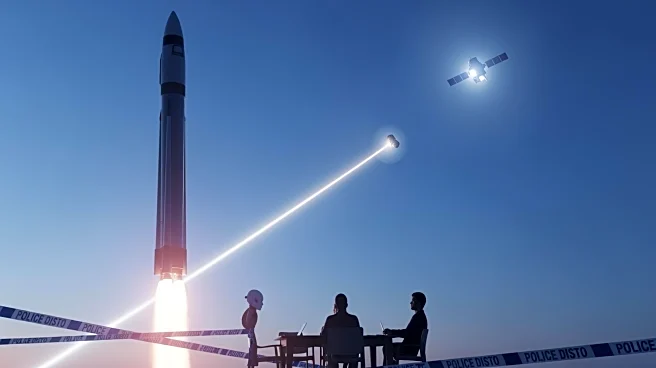
Japan's H3 rocket, launched by the Japan Aerospace Exploration Agency (JAXA), experienced a failure on December 22, 2025, when its upper stage encountered an anomaly. The issue arose with the LE-5B-3 engine, which uses liquid hydrogen and liquid oxygen.
The second ignition of the engine failed to start normally and shut down prematurely, preventing the QZS-5 satellite from reaching its intended orbit. The rocket had initially lifted off successfully from the Tanegashima Space Center, with the first stage performing nominally. However, the second stage, which was supposed to burn for over four minutes, ended abruptly. This failure marks the second time the H3 rocket has faced a second-stage anomaly since its debut in March 2023. Despite this setback, Mitsubishi Heavy Industries and JAXA have conducted five successful missions with the H3 rocket, including the recent launch of the HTV-X cargo spacecraft to the International Space Station.
Why It's Important?
The failure of the H3 rocket's upper stage is significant as it impacts Japan's efforts to enhance its local navigation capabilities through the Quasi-Zenith Satellite System (QZS). The QZS-5 satellite was intended to augment the Global Positioning System (GPS) managed by the United States, providing improved navigation services in Japan. The anomaly not only delays the deployment of this critical satellite but also raises concerns about the reliability of the H3 rocket program. This incident could affect future launches and necessitate a thorough investigation to identify and rectify the cause of the failure. The outcome of this investigation will be crucial for JAXA and Mitsubishi Heavy Industries to restore confidence in the H3 rocket's capabilities and ensure the success of subsequent missions.
What's Next?
JAXA has stated that it will be impossible to proceed with the next H3 rocket launch without determining the cause of the failure and implementing preventive measures. This indicates that a detailed investigation will be conducted to understand the anomaly and develop solutions to prevent similar issues in future launches. The findings of this investigation will likely influence the timeline for upcoming missions and could lead to design or procedural changes in the H3 rocket program. Stakeholders, including JAXA, Mitsubishi Heavy Industries, and the Japanese government, will be closely monitoring the situation to ensure the reliability and success of future space endeavors.