







What's Happening?
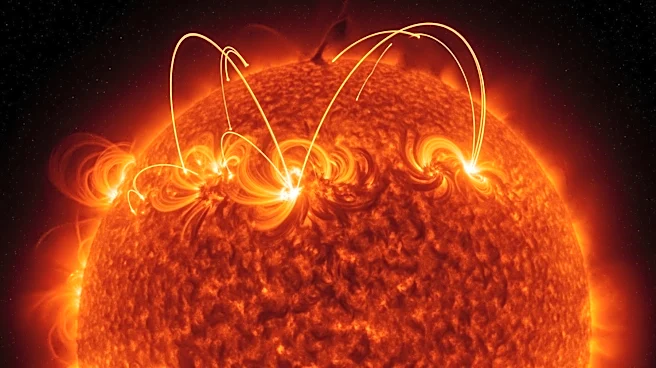
The sun has emitted two powerful X-class solar flares within a span of seven hours, originating from the sunspot region AR4419 on the sun's western limb. The first flare peaked at 9:07 p.m. EDT on April 23, followed by the second at 4:14 a.m. EDT on April 24.
These flares are the strongest observed in the past 78 days, according to solar physicist Ryan French. The radiation bursts from these flares caused significant radio blackouts on the sunlit side of Earth, initially affecting parts of the Pacific Ocean and Australia, and later impacting East Asia. The sunspot region responsible for these flares is expected to rotate out of view soon, but not before showcasing a series of M-class flares and a rare 'sympathetic flare' event.
Why It's Important?
The occurrence of these X-class solar flares is significant due to their potential impact on Earth's communication systems. Solar flares release intense electromagnetic radiation, which can ionize the Earth's ionosphere, disrupting shortwave radio communications. This can affect aviation, maritime operations, and emergency services that rely on these frequencies. Additionally, the flares were accompanied by coronal mass ejections (CMEs), which, if directed towards Earth, could trigger geomagnetic storms. Such storms can disrupt power grids, satellite operations, and even lead to vivid aurora displays. Monitoring these solar activities is crucial for preparing and mitigating potential disruptions to technological infrastructure.
What's Next?
Forecasters are currently modeling the paths of the CMEs associated with these flares to determine if they will impact Earth. While the sunspot's position on the sun's western edge makes a direct hit unlikely, a glancing blow could still occur, potentially leading to geomagnetic storm conditions. If this happens, it could result in further disruptions to communication systems and power grids, as well as enhanced auroral activity. Scientists and space weather agencies will continue to monitor the situation closely to provide timely warnings and updates.