





What's Happening?
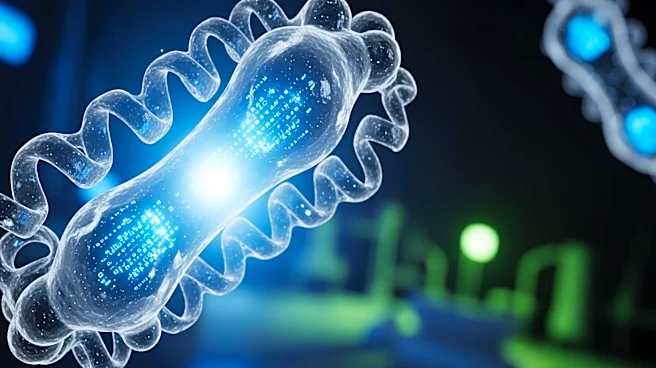
The Hong Kong Polytechnic University (PolyU) has pioneered a novel method for data storage using engineered proteins, addressing the growing demand for efficient and sustainable data storage solutions driven by AI and big data. Led by Professor Zhongping
Yao, the interdisciplinary team has developed a system that encodes digital data into sequences of amino acids within proteins, offering superior storage capacity, stability, and encryption capabilities. This breakthrough, published in Nature Communications, leverages the biocompatibility and longevity of proteins, providing a scalable alternative to traditional storage media like DNA, which faces limitations in density and stability.
Why It's Important?
As digital data generation accelerates, traditional storage solutions are reaching their limits, necessitating innovative approaches. Protein-based data storage offers a promising alternative, with the potential to revolutionize data preservation by providing higher density and stability. This technology could significantly impact industries reliant on large-scale data storage, such as cloud computing, AI, and biotechnology. The ability to store data within living organisms also opens new possibilities for bioinformatics and personalized medicine, where biological systems could inherently retain digital information, enhancing data integration and accessibility.
What's Next?
The PolyU team plans to further develop this technology, focusing on mass storage scalability, cost reduction, and the integration of additional functionalities. Future research will aim to enhance the efficiency of data writing and retrieval processes, potentially leading to widespread adoption of protein-based storage systems. The team also envisions exploring the use of different protein scaffolds to improve performance and expand the technology's applications. As the demand for sustainable data storage solutions grows, this innovation could play a crucial role in meeting the needs of data-intensive industries.