





What's Happening?
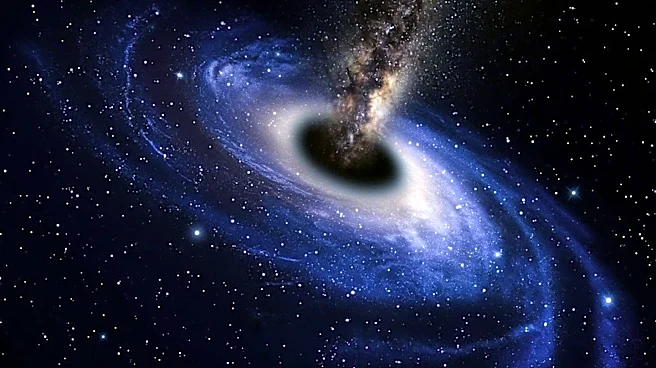
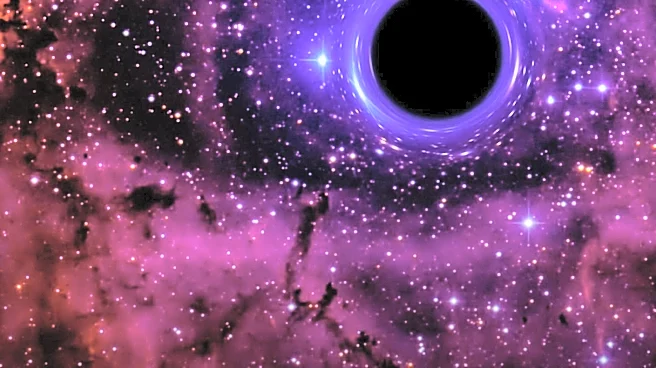
Recent research indicates that many binary black hole pairs, which are black holes orbiting each other, are formed through 'hierarchical mergers.' This means that one of the black holes in the pair is a large, fast-spinning black hole that resulted from
a previous merger, and it subsequently found another partner in the cosmos. Traditionally, it was thought that most binary black holes originated from stars that lived and died together, collapsing into a pair that eventually merged. However, new studies, including one led by Cailin Plunkett, a Ph.D. candidate at the Massachusetts Institute of Technology, suggest that approximately 14 percent of black hole duos may be hierarchical mergers. These findings are based on analyzing data from the Laser Interferometer Gravitational-Wave Observatory (LIGO) and other observatories, which track merging black holes through the spacetime ripples they release.
Why It's Important?
This new understanding of hierarchical mergers in binary black holes significantly impacts our comprehension of supernova physics and how galaxies evolve. Knowing the origin stories of black holes is crucial for refining models of general relativity and piecing together the history of the universe. The discovery of these 'odd couple' black holes, characterized by one being much larger, spinning faster, and orbiting out of alignment with its partner, provides concrete evidence for previously theoretical predictions. This challenges the conventional view of black hole formation and suggests a more dynamic and complex process of cosmic evolution. The ability of two different technical processes to independently find evidence of these black hole origins strengthens the scientific community's confidence in these findings, marking a significant step forward in astrophysics.
What's Next?
Scientists will continue to analyze data from LIGO and other observatories to further investigate the prevalence and characteristics of hierarchical black hole mergers. Future research will likely focus on refining the percentage of such mergers and exploring the specific astrophysical environments where these events are most likely to occur. This will involve developing more sophisticated models to simulate black hole interactions and mergers, aiming to better understand the conditions that lead to the formation of these 'odd couple' pairs. The insights gained will contribute to a more complete picture of black hole populations and their role in the gravitational wave universe, potentially leading to new discoveries about the fundamental forces of nature.
Beyond the Headlines
The revelation of hierarchical black hole mergers has deeper implications for our understanding of the universe's fundamental processes. It highlights the dynamic and interconnected nature of cosmic events, where the remnants of one cataclysmic event can go on to participate in another. This continuous cycle of formation and merger contributes to the growth of supermassive black holes and the evolution of galaxies. The research also underscores the power of gravitational wave astronomy, which allows scientists to 'listen' to the universe in a new way, revealing phenomena that are invisible to traditional telescopes. This new perspective is not only advancing astrophysics but also pushing the boundaries of our technological capabilities and our philosophical understanding of the cosmos.