



What's Happening?
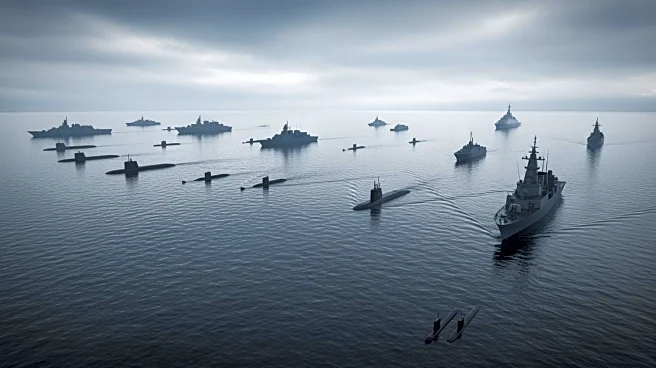
China has initiated significant military exercises around Taiwan, described as a 'stern warning' in response to the United States' recent approval of a substantial arms sale to Taiwan. The Chinese military's maneuvers include naval and air forces approaching
the island, conducting blockade and control operations, and live-fire drills. These actions are part of 'Justice Mission 2025,' involving 89 aircraft and 28 naval vessels. Taiwan's military has responded by deploying forces and conducting rapid-response drills, asserting its readiness to defend itself. The drills have disrupted flights, affecting over 100,000 travelers, and have been classified by Taiwan as 'gray-zone' tactics intended to pressure the island into submission.
Why It's Important?
The military exercises underscore the escalating tensions between China and Taiwan, with significant implications for regional stability and international relations. The drills are a direct response to the US arms sale to Taiwan, valued at over $11 billion, which Beijing perceives as a threat to its sovereignty. This development highlights the delicate balance of power in the Asia-Pacific region and the potential for conflict. The situation also tests the US's ambiguous policy regarding military intervention in Taiwan's defense, raising questions about future US-China relations and the security of Taiwan.
What's Next?
The continuation of military exercises by China around Taiwan is likely to provoke further diplomatic tensions. Taiwan may seek additional international support to bolster its defense capabilities. The US, while committed to arming Taiwan, faces a complex decision on whether to provide direct military support in the event of an escalation. The international community will be closely monitoring the situation, as any miscalculation could lead to a broader conflict involving major global powers.
Beyond the Headlines
The drills reflect China's broader strategy to assert its influence in the region and deter external interference. The situation raises ethical and legal questions about sovereignty and the right to self-determination. It also highlights the long-term geopolitical shifts as China seeks to expand its military capabilities and influence, challenging the existing international order. The outcome of this standoff could redefine power dynamics in the Asia-Pacific region for years to come.