





What's Happening?
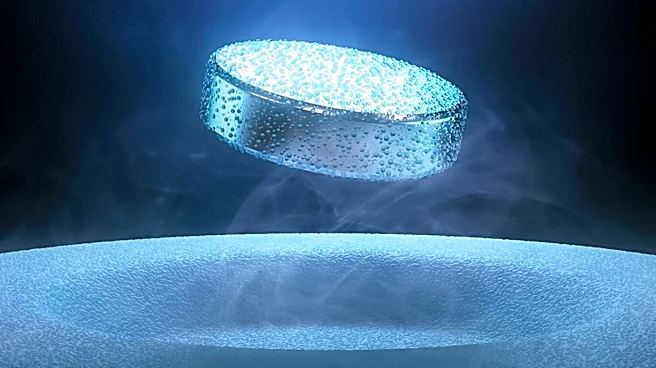
Researchers, including Miguel Gonçalves of Princeton Center for Theoretical Science, have demonstrated a novel mechanism for achieving chiral superconductivity by introducing holes into a Chern ferromagnet. Their calculations indicate a unique pairing
mechanism where a Cooper pair forms from a magnon bound to two holes. This pairing exhibits chiral f-wave symmetry and a noncoplanar skyrmionic spin texture. The study found that increasing Ising spin-orbit coupling can shift interactions between these skyrmion Cooper pairs from repulsive to attractive, creating conditions for chiral superconductivity. This research utilizes the repulsive Kane-Mele-Hubbard model and involves complex numerical methods like exact diagonalization and density-matrix-renormalization-group calculations to analyze the system's quantum properties. The findings suggest a potential explanation for recently observed superconductivity in the MoTe2 moiré superlattice.
Why It's Important?
This research is significant for advancing the understanding of unconventional superconductivity, a long-standing challenge in condensed matter physics. By identifying a new microscopic mechanism for chiral superconductivity, it opens avenues for designing novel superconducting materials. Unlike previous proposals that required external magnetic fields, this mechanism achieves spontaneous spin polarization, simplifying potential experimental realization. The ability to model and understand these interactions provides a framework for exploring similar phenomena in other materials, particularly in moiré materials where topology and magnetism are intertwined. This could lead to breakthroughs in quantum computing and other fields that rely on advanced material properties, potentially impacting technology development and industrial applications in the U.S. and globally.
What's Next?
The researchers' findings provide a theoretical foundation that could guide future experimental verification. The identification of a specific, albeit narrow, intermediate-SOC regime where chiral superconductivity can emerge suggests that further research will likely focus on experimentally realizing these conditions in materials like the MoTe2 moiré superlattice. Future work may also involve a more exhaustive parameter model scan to identify broader conditions under which this regime can be stabilized. The insights gained could lead to the development of new materials with tailored superconducting properties, potentially impacting the design of quantum sensors, fault-tolerant quantum computers, and other advanced technologies. Continued collaboration between theoretical and experimental physicists will be crucial in translating these theoretical predictions into practical applications.
Beyond the Headlines
The implications of this research extend beyond immediate material science, touching upon fundamental aspects of quantum mechanics and condensed matter physics. The discovery of a Cooper pair formed by a magnon bound to two holes represents a departure from conventional electron-based pairings, highlighting the complex and diverse ways superconductivity can manifest. This work contributes to the broader understanding of how quantum phenomena, such as superposition and entanglement, can be harnessed for technological advancements. The focus on moiré superlattices also underscores the growing importance of engineered quantum materials in exploring new physics and developing next-generation devices. Ultimately, this research could contribute to a deeper understanding of the universe's fundamental laws and unlock new possibilities for energy, computing, and sensing technologies.