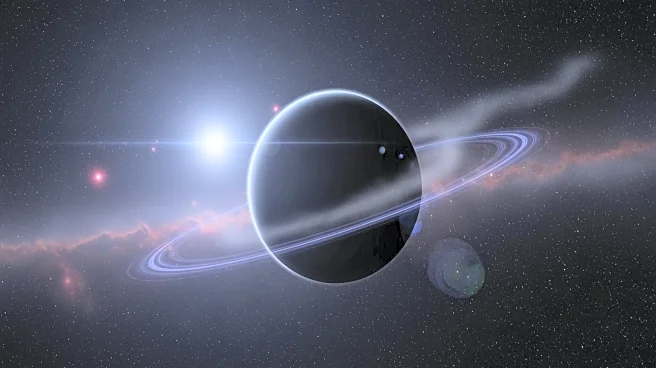




What's Happening?
Astronomers have identified a unique exoplanet, PSR J2322-2650b, located over 700 light years from Earth. This planet, observed using the James Webb Space Telescope, is notable for its lemon-like shape and a carbon-rich atmosphere, which is unlike any
previously observed. The exoplanet orbits a pulsar, a type of dense dead star, which influences its shape and atmospheric conditions. The atmosphere is dominated by molecular carbon, a rarity since carbon typically forms compounds like carbon dioxide. This unusual composition suggests the presence of soot clouds that could solidify into diamonds within the planet's core. The discovery challenges existing theories about planetary formation, particularly in 'black widow' systems, where a pulsar typically erodes its stellar companion.
Why It's Important?
The discovery of PSR J2322-2650b is significant as it challenges current understanding of planetary formation and the dynamics of 'black widow' systems. These systems are typically characterized by a pulsar eroding a companion star, but the presence of a planet in such a system is rare. The unique atmospheric composition of the exoplanet, rich in molecular carbon, raises questions about the processes that led to its formation. This finding could lead to new insights into the evolution of planetary systems and the potential for similar planets elsewhere in the universe. It also highlights the capabilities of the James Webb Space Telescope in uncovering new astronomical phenomena.
What's Next?
Further observations and studies are needed to understand the formation and evolution of PSR J2322-2650b. Astronomers aim to determine whether its composition is unique or representative of a new class of exoplanets. This could involve observing similar systems to see if they share the same characteristics. The findings may prompt revisions to existing models of planetary formation, particularly in extreme environments like those around pulsars. Continued research could also explore the potential for other planets with similar atmospheric conditions, expanding our understanding of the diversity of planetary systems in the universe.