



What's Happening?
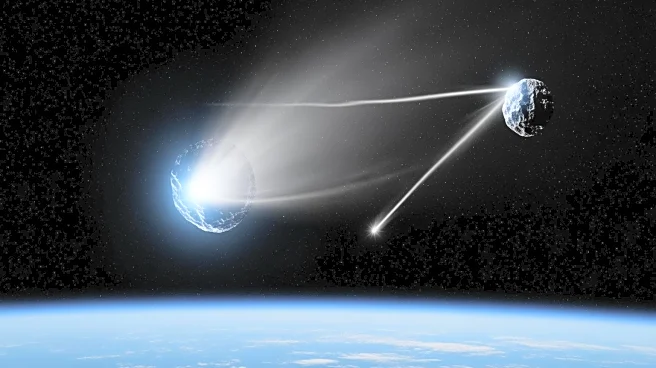
The interstellar object 3I/ATLAS is approaching Earth, coming within 167 million miles. Astronomers have observed a peculiar feature: an anti-tail pointing towards the Sun, contrary to typical comet tails. This anomaly has sparked debate among scientists.
Harvard astronomer Avi Loeb suggests the anti-tail results from enhanced mass loss on the Sun-facing side, causing larger fragments to accumulate. Others propose it is a dust tail composed of solid particles. The object provides a unique opportunity for study, as it is only the third known interstellar object to enter our solar system.
Why It's Important?
The study of 3I/ATLAS offers insights into the behavior of interstellar objects and their interactions with solar radiation. Understanding these phenomena can enhance knowledge of cometary physics and the dynamics of objects from beyond our solar system. The observations challenge existing models and may lead to new theories about the composition and behavior of interstellar objects. This research is crucial for expanding our understanding of the solar system's interactions with the broader cosmos and the nature of objects that traverse interstellar space.
What's Next?
As 3I/ATLAS continues its journey, astronomers will use both ground-based and space telescopes to gather more data. These observations will help refine models of interstellar object behavior and improve predictions of their trajectories and interactions with solar radiation. The scientific community will continue to debate the nature of the anti-tail, with further studies potentially resolving the mystery. The findings may also inform future missions to study interstellar objects, enhancing our understanding of these rare cosmic visitors.