




What's Happening?
Former Senator Joe Manchin (I-W.Va.) is calling for open primaries to foster a more 'representative form of government.' Manchin, who recently launched the Independent Leadership Council with his daughter Heather Bresch, believes the current electoral
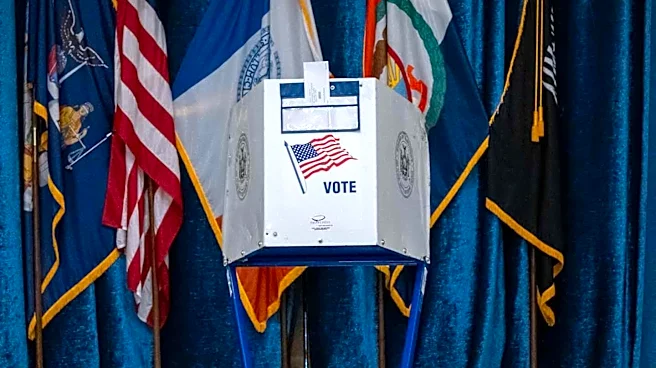
system lacks competition, citing that 395 out of 435 congressional districts are predetermined. His initiative aims to support and elect independent candidates who can work across party lines, rather than forming a new political party. Manchin suggests that opening primaries would allow more candidates to participate, followed by a general election where the winning candidate must secure a majority (50% plus one vote) rather than just a plurality. This approach, he argues, would lead to a more truly representative government by ensuring elected officials have broader support.
Why It's Important?
Manchin's push for open primaries and majority-vote general elections addresses a fundamental concern about the health of American democracy: the perceived lack of competition and representation in congressional races. The statistic that 395 out of 435 districts are predetermined highlights a system where many voters feel their voices are not adequately heard, potentially leading to disengagement and political polarization. By advocating for independent candidates and a shift away from the two-party dominance, Manchin's efforts could introduce more diverse perspectives into policy-making and encourage bipartisan cooperation. This initiative could empower voters by giving them more choices beyond traditional party lines and potentially lead to more moderate and consensus-driven governance, which could have significant implications for national policy and legislative effectiveness.
What's Next?
The Independent Leadership Council, led by former Senator Manchin, will continue its efforts to build support and infrastructure for independent candidates in congressional races. Their focus will be on identifying and backing individuals committed to independent voices, capable of collaborating with both Democrats and Republicans. The success of this movement will depend on its ability to attract viable candidates and garner public support in a political landscape traditionally dominated by two major parties. Future steps will likely involve increased outreach, fundraising, and strategic campaigning in key districts to demonstrate the feasibility and benefits of independent representation. The impact of these efforts will be closely watched as the political system grapples with calls for greater inclusivity and responsiveness.
Beyond the Headlines
The call for open primaries and majority voting extends beyond mere procedural changes; it touches upon the core principles of democratic fairness and voter empowerment. The current system, often criticized for gerrymandering and partisan entrenchment, can lead to a sense of disenfranchisement among the electorate. Manchin's proposal implicitly challenges the notion that political power must reside solely within established party structures. By promoting independent candidates, the initiative could foster a political culture where merit and policy positions are prioritized over party loyalty. This could lead to a more dynamic political discourse, potentially reducing gridlock and encouraging innovative solutions to national challenges. The long-term implications could include a re-evaluation of electoral processes across the U.S., potentially inspiring similar movements in other states or at different levels of government.