





What's Happening?
A new study indicates that the ability of neutrinos to change 'flavors' (electron, muon, and tau) might significantly influence whether massive stars explode as supernovas or collapse into black holes. When a massive star's core collapses, it releases
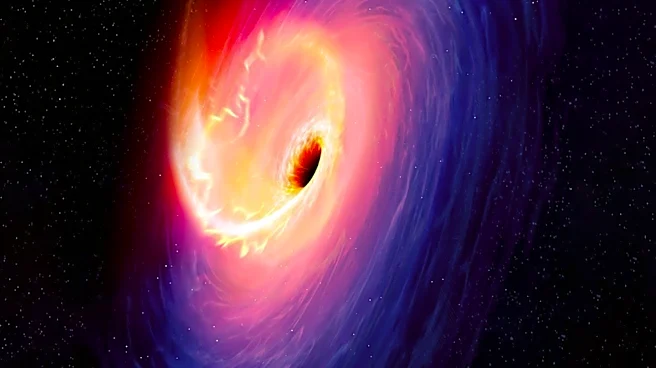
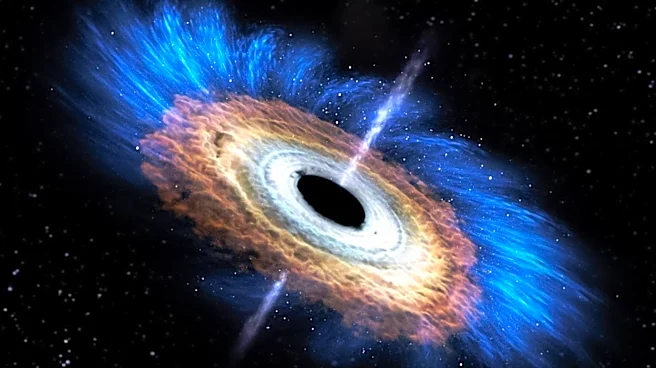
a tremendous amount of neutrinos. These neutrinos can interact with the star's outer layers, potentially heating them enough to trigger a supernova explosion, leaving behind a neutron star. However, if this heating is insufficient, the star collapses to form a black hole. The study, which simulated the collapse of 195 stars ranging from nine to 120 solar masses, found that neutrino flavor conversion could make it less likely for massive stars to explode as supernovas and more likely to form black holes. This finding could help explain why fewer supernovas are observed than theoretically predicted and why some red supergiant stars appear to vanish without an explosion.
Why It's Important?
This research is important because it refines our understanding of stellar evolution and the origins of elements in the universe. Supernovas are crucial for distributing heavy elements, which are essential for the formation of planets and life, throughout the cosmos. A more accurate model of which stars become supernovas and which form black holes directly impacts our understanding of the chemical enrichment of galaxies and the conditions necessary for planetary system formation. The study's implications for the observed number of supernovas and the existence of less massive neutron stars could lead to a re-evaluation of current astrophysical models. For U.S. scientific institutions and researchers, these findings provide new avenues for theoretical and observational astronomy, potentially guiding future telescope observations and particle physics experiments aimed at understanding neutrino behavior.
What's Next?
The scientists plan to incorporate more realistic models of neutrino behavior into 3D computer simulations of massive stars. This will allow them to study how neutrino flavor changes initiate and evolve over time as stars die, providing a more dynamic and accurate picture of stellar collapse. Future research will also likely involve further observational efforts to detect and characterize supernovas and black holes, comparing these observations with the refined theoretical predictions. This interdisciplinary approach, combining particle physics and astrophysics, will be crucial for validating the study's findings and potentially uncovering new aspects of neutrino physics and stellar dynamics. The ongoing development of neutrino detectors could also play a role in directly observing these flavor changes in astrophysical events.
Beyond the Headlines
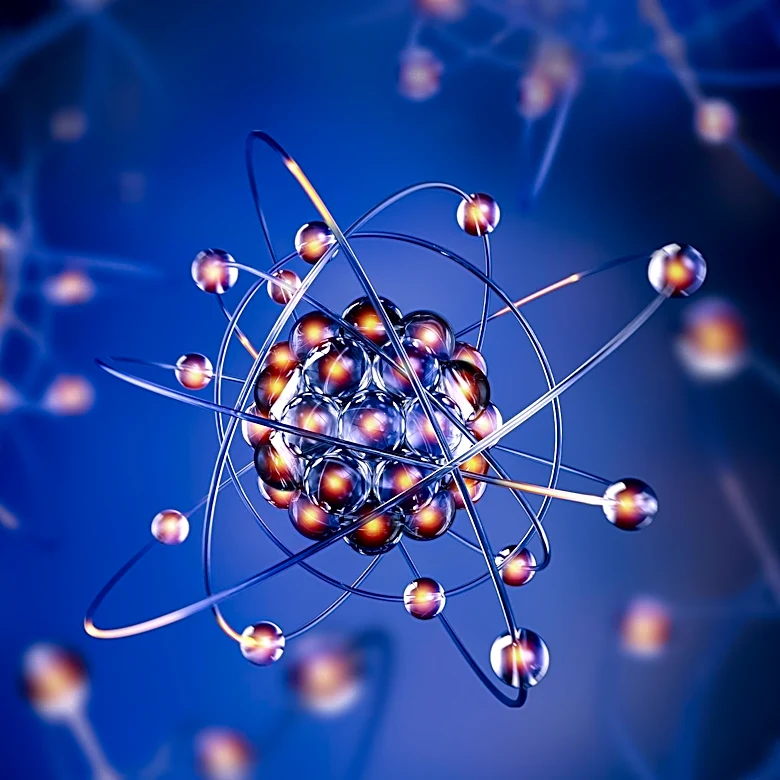
The study delves into the fundamental nature of neutrinos, often called 'ghost particles' due to their minimal interaction with matter. The concept of neutrino oscillation, which earned a Nobel Prize in 2015, is a cornerstone of modern particle physics, and this research extends its implications to cosmic scales. The idea that these tiny, elusive particles can dictate the ultimate fate of massive stars—whether they explode in a brilliant supernova or silently collapse into a black hole—highlights the interconnectedness of the universe's smallest and largest phenomena. It underscores how subtle quantum mechanical properties can have profound macroscopic consequences, influencing the very fabric of the cosmos and the distribution of matter that eventually forms everything we see, including ourselves.