







What's Happening?
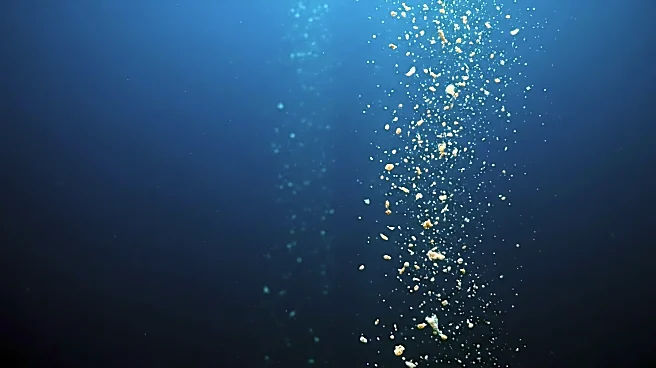
Scientists from the University of Southern Denmark have discovered that deep-sea microbes have access to a previously unrecognized food source, which could alter the understanding of marine ecosystems and the Earth's carbon cycle. The study reveals that marine snow,
composed of organic particles, releases dissolved carbon and nitrogen as it sinks into the deep ocean. This process, driven by hydrostatic pressure, provides an immediate nutrient source for surrounding microbes. The research, published in Science Advances, indicates that up to 50% of the carbon and 58-63% of the nitrogen in marine snow can leak out during its descent. This finding challenges the assumption that most carbon from marine snow is buried in ocean sediments, suggesting instead that much of it remains in deep ocean waters, potentially affecting climate models.
Why It's Important?
The discovery has significant implications for understanding the Earth's carbon cycle. If less carbon is stored in ocean sediments than previously thought, it could alter predictions about carbon sequestration and climate change. The leaked carbon remains in the deep ocean for extended periods, influencing how much carbon the ocean can store and for how long. This process is crucial for climate models and understanding long-term carbon storage. The research highlights the need to reassess the role of marine snow in carbon cycling and its impact on global climate processes.
What's Next?
The research team plans to extend their study to the Arctic Ocean, aiming to detect molecular signatures of this nutrient leakage in natural settings. This future expedition aboard the German research vessel Polarstern will help confirm whether the laboratory findings are applicable across the world's oceans. Such confirmation could lead to a reevaluation of current climate models and carbon cycle predictions, potentially influencing environmental policies and conservation strategies.