



What's Happening?
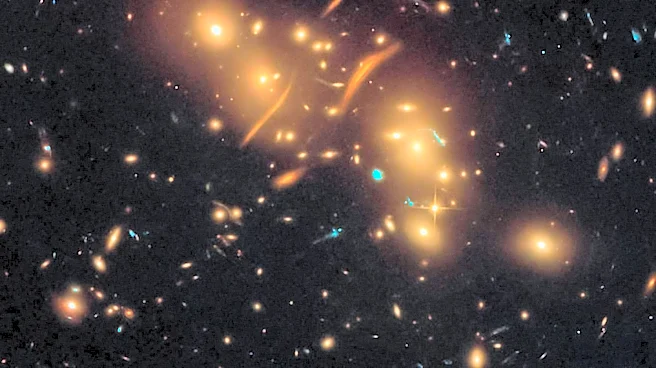
Scientists have made a groundbreaking discovery of a rare extragalactic stellar stream in the ultra-diffuse galaxy UGC 9050-Dw1, located 115 million light-years from Earth. This marks the first time such a stellar stream, a thin, curved band of stars
unraveling from a globular cluster, has been observed outside our own Milky Way galaxy. The unique visibility of this stream was attributed to the ultra-diffuse nature of UGC 9050-Dw1, which has a sparse population of stars, allowing the stream to stand out against an unusually dark background. Researchers, including Tjitske Starkenburg of Northwestern University, utilized this discovery to measure the distribution of dark matter within the distant galaxy by modeling the galaxy's gravitational effects on the stellar stream. The findings, published in Nature, are consistent with previous, more orthodox measurements of dark matter in this galaxy.
Why It's Important?
This discovery is significant because it provides astronomers with a completely new and independent tool for measuring dark matter distribution in distant galaxies. Dark matter, an invisible substance that interacts only gravitationally, remains one of the universe's greatest mysteries. Understanding its nature and distribution is crucial for comprehending galaxy formation, evolution, and the overall structure of the cosmos. The ability to validate existing dark matter measurement techniques with a novel method strengthens the scientific community's confidence in current cosmological models. Furthermore, extending this measurement capability beyond the Milky Way opens up vast new avenues for research, allowing scientists to study dark matter in diverse galactic environments and potentially uncover new insights into its properties.
What's Next?
The co-authors of the study anticipate that this discovery is just the beginning, expecting more extragalactic stellar streams to be found in the future. This optimism is fueled by the fact that the current discovery was made using archival data from the Hubble Space Telescope. With the advent of new, next-generation telescopes, such as the Nancy Grace Roman Telescope, which boasts a field of view 100 times larger than Hubble, the likelihood of identifying additional stellar streams is significantly increased. This suggests an accelerated pace of discovery in dark matter research, potentially leading to a deeper understanding of this enigmatic component of the universe and refining our models of galactic dynamics and cosmic evolution.
Beyond the Headlines
The quest to understand dark matter represents a fundamental pursuit in modern astrophysics, pushing the boundaries of human knowledge about the universe's composition. This discovery underscores the iterative nature of scientific progress, where new observational techniques and technological advancements continually refine our understanding of cosmic phenomena. The implications extend beyond astronomy, potentially influencing theoretical physics by providing empirical data to test and develop new models of fundamental particles and forces. The ability to 'see' the gravitational effects of dark matter through such subtle cosmic structures highlights the ingenuity of scientific inquiry and the profound mysteries that still lie hidden in the vastness of space, awaiting discovery by future generations of researchers.