





What's Happening?
A powerful M1.4-class solar flare erupted from sunspot region AR4549 on October 6, launching a coronal mass ejection (CME) towards Earth. Early observations and modeling, including NOAA's WSA-ENLIL model, suggest the leading edge of this CME is expected
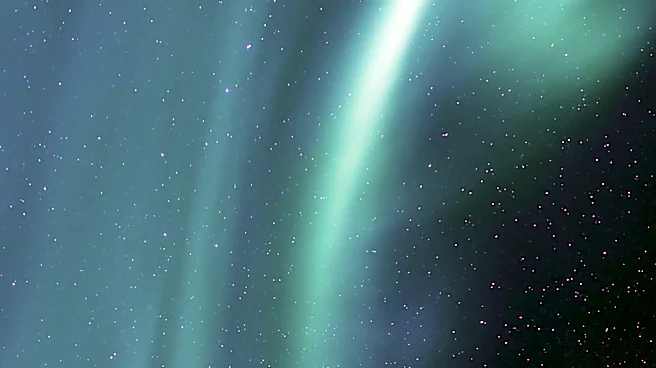
to reach Earth around 1 a.m. EDT (0500 GMT) on October 9. Forecasters at Belgium's Solar Influences Data Analysis Center (SIDC) estimate the CME is traveling at approximately 560 km/s and has an Earth-directed component. This event has captured the attention of aurora chasers, as it could lead to enhanced Northern Lights displays, potentially visible at lower latitudes than usual. However, the exact strength of the geomagnetic storm and how far south the auroras will be visible remain uncertain, as CME arrival forecasts carry inherent variability.
Why It's Important?
This solar event is important because it has the potential to significantly impact Earth's magnetosphere, leading to a geomagnetic storm. Such storms can cause spectacular aurora displays, offering a unique natural phenomenon for skywatchers across the U.S., particularly in northern states. Beyond the visual spectacle, geomagnetic storms can have practical implications. Stronger storms can disrupt satellite communications, GPS systems, and power grids, although the current forecast suggests minor to isolated moderate storm conditions. For industries reliant on precise satellite navigation or stable power infrastructure, even minor disruptions can necessitate precautionary measures. The event also highlights the ongoing efforts in space weather forecasting, which is crucial for mitigating potential impacts on technology and infrastructure.
What's Next?
Space weather forecasters will continue to analyze coronagraph observations and refine their models to determine the CME's precise trajectory, speed, and expected arrival time. Updates on the potential strength of the geomagnetic storm and the visibility of the Northern Lights will be issued as more data becomes available. Aurora chasers and the public are advised to monitor official space weather forecasts for the latest information, especially for October 9. If conditions align, with a strong southward component in the CME's magnetic field, the auroras could be intensified and extend to lower latitudes. Additionally, sunspot region AR4549 and another prominent region, AR4545, are currently facing Earth and have shown increased flare activity, meaning further solar eruptions could occur in the coming days, potentially leading to more space weather events.
Beyond the Headlines
The occurrence of this M-class solar flare and the subsequent CME underscores the dynamic nature of our sun and its continuous interaction with Earth's environment. These events are a reminder of the vulnerability of modern technological infrastructure to space weather phenomena. While the primary focus is often on the visual spectacle of the auroras, the underlying science involves complex plasma physics and magnetic field interactions that are critical for understanding our solar system. The ongoing research and development in space weather prediction are vital for protecting assets in orbit and on the ground, from communication satellites to power grids. This event also serves as a public engagement opportunity, raising awareness about solar activity and its effects, encouraging scientific curiosity, and highlighting the importance of continuous space observation and research.