





What's Happening?
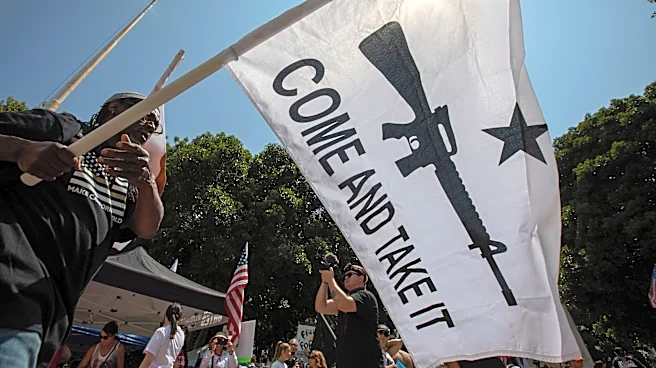
The Supreme Court has declined to review a case involving a Michigan third grader who wore a hat featuring an AR-style rifle and the phrase 'come and take it' during her school's 'Great Kindness Challenge' in 2022. The student chose the hat to support
gun rights and in memory of her father. School officials at Robert Kerr Elementary in Durand, Michigan, argued that the hat's message could be disruptive, especially for students who had transferred after a nearby school shooting in 2021. Both the district court and the 6th U.S. Circuit Court of Appeals ruled against the student, stating that the school's concerns about disruption were reasonable. The case was compared to a 1969 Supreme Court decision that protected students' First Amendment rights as long as their speech was not disruptive. However, the courts found the school's actions justified due to the context of the 2021 shooting and the age of the students.
Why It's Important?
This decision underscores the ongoing debate over the balance between free speech rights and school safety. The Supreme Court's refusal to hear the case leaves the lower court's ruling intact, which may influence how schools across the U.S. handle similar situations involving student expression and potentially provocative messages. The case highlights the challenges schools face in maintaining a safe environment while respecting students' rights. It also reflects broader societal tensions around gun rights and free speech, particularly in educational settings. The outcome may embolden schools to enforce dress codes that limit expressions deemed disruptive, potentially affecting students' ability to express political or social views.
What's Next?
With the Supreme Court declining to hear the case, the lower court's decision stands, potentially setting a precedent for future cases involving student expression and school dress codes. Schools may feel more empowered to enforce policies that restrict certain types of expression, especially those related to controversial issues like gun rights. This could lead to further legal challenges as students and parents test the boundaries of free speech in educational settings. Additionally, the decision may prompt schools to review and possibly revise their dress codes to ensure they are prepared to address similar situations in the future.