





What's Happening?
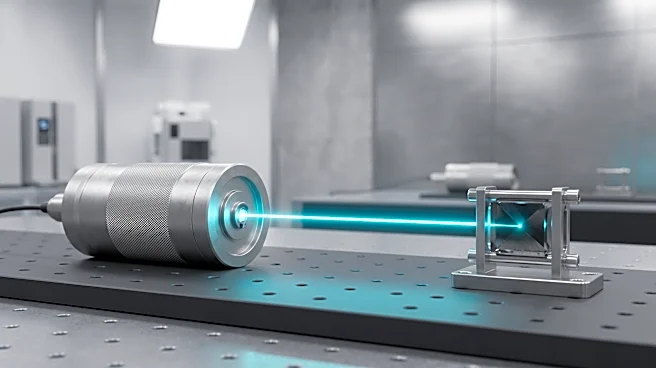
IonQ has announced a significant breakthrough in quantum computing, demonstrating a quantum link capable of over 1,000 entanglement events per second. This achievement connects two distinct types of qubits: a trapped-ion qubit and a silicon-vacancy (SiV)
qubit within a solid-state memory. The connection is facilitated by a photonic interconnect, which uses light to carry the quantum information. This rate surpasses previous records for trapped-ion systems by more than four times, addressing a critical challenge in building larger quantum computers by enabling more efficient exchange of quantum information between separate systems. The company's approach combines the strengths of trapped ions, known for their qubit coherence, with silicon-vacancy centers in diamond, which are efficient in interacting with light and suitable for quantum memories. This development is crucial for coordinating separate processors and distributing computational workloads across multiple machines in quantum networks.
Why It's Important?
This breakthrough by IonQ is important because it tackles a major hurdle in the scalability of quantum computing. By achieving a high-speed quantum interconnect, IonQ is paving the way for the development of larger and more powerful quantum computers. The ability to efficiently link different hardware systems without creating communication bottlenecks means that quantum systems can scale beyond individual machines, much like conventional data centers evolved with specialized processors, memory, and networking. This advancement could accelerate the timeline for practical quantum applications across various U.S. industries, including finance, healthcare, and defense, by enabling more complex computations. Furthermore, the underlying design's potential compatibility with other quantum computing architectures, such as neutral-atom systems and superconducting qubits, broadens its impact and could foster a more integrated quantum ecosystem. The commercialization efforts, including sales to the University of Maryland and South Korean company SDT, indicate a growing market for this advanced technology.
What's Next?
IonQ is actively pursuing quantum networking through the Defense Advanced Research Projects Agency’s (DARPA) HARQ program, which aims to develop high-speed interconnects compatible with diverse quantum computing architectures. This suggests continued research and development to further refine and expand the capabilities of their quantum link technology. The company expects its underlying design to be adaptable to various quantum platforms, including neutral-atom systems and superconducting qubits, which could lead to broader applications and collaborations within the quantum computing community. With the commercialization of its quantum memory and interconnect technology already underway, as evidenced by sales to the University of Maryland and SDT, IonQ is likely to continue seeking new partnerships and customers. Future developments may include integrating this high-speed interconnect into more complex quantum systems and exploring its potential for networked sensing, where connected quantum devices coordinate measurements across different locations.
Beyond the Headlines
The achievement of a high-speed quantum interconnect by IonQ has profound implications beyond immediate computational gains. It signifies a crucial step towards realizing a distributed quantum computing paradigm, where quantum information can be seamlessly shared and processed across geographically dispersed quantum machines. This could lead to the creation of a 'quantum internet,' enabling secure communication and distributed quantum sensing applications with unprecedented precision. Ethically, the development of such powerful quantum networking capabilities raises questions about data security and privacy in a quantum-enabled world, as quantum entanglement could offer new methods for secure communication but also potentially new vulnerabilities if not properly managed. Culturally, this advancement pushes the boundaries of what is considered computationally possible, potentially inspiring new scientific discoveries and technological innovations that are currently unimaginable. The long-term shift could be a fundamental change in how information is processed and secured globally, with the U.S. at the forefront of this technological revolution.